

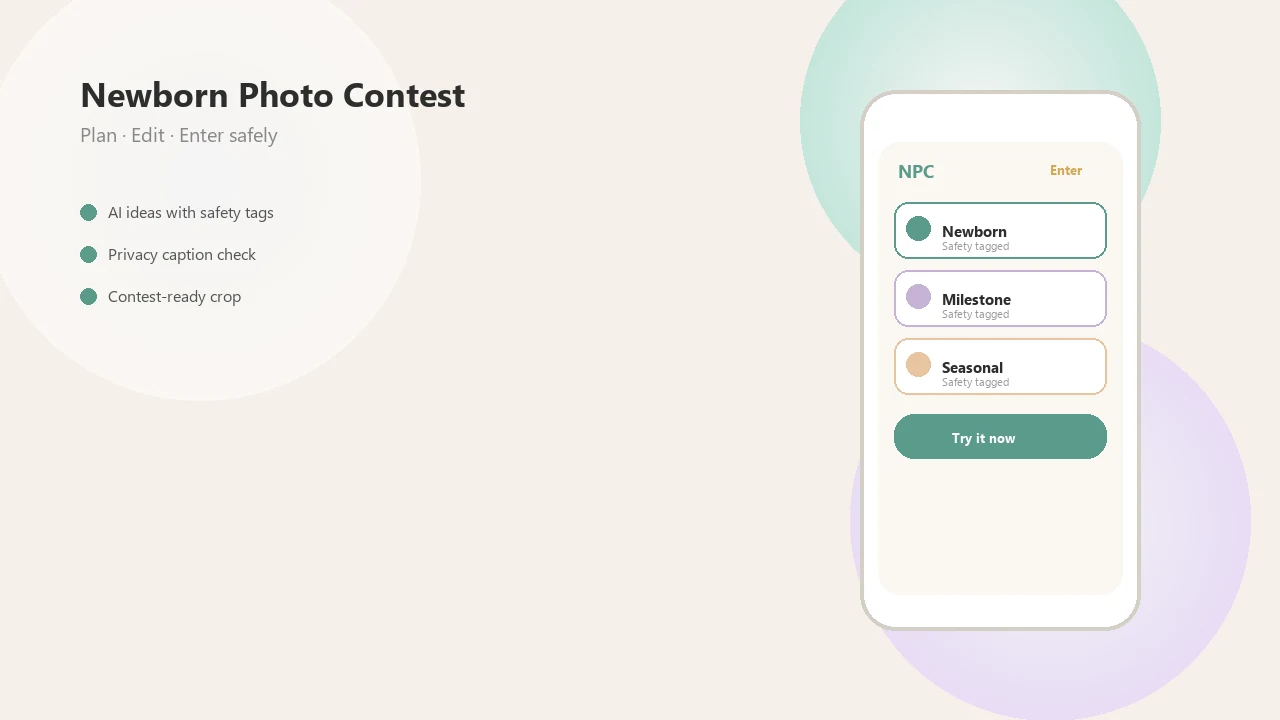
Definition: A baby photo contest platform for brands is contest management software that lets companies collect, moderate, and showcase parent-submitted baby photos while controlling voting integrity, legal compliance, and prize fulfillment.
Best Baby Photo Contest Platforms For Brands: Named Shortlist
The strongest baby photo contest platforms differ by audience: some are public contest communities, while others support branded campaigns, parent sharing, or newborn-specific creative planning.
- Newborn Photo App: Best for brands that want contest-ready newborn photo guidance, safe setup prompts, captions, and crop planning before families submit. NPC fits family, baby care, gifting, and photo-print campaigns because the workflow starts with an age-appropriate pose and simple backdrop, not only an upload button. For brand teams, the useful differentiator is the pre-submission layer: NPC helps families create eligible, appropriately cropped newborn photos before moderation and voting tools have to reject them.
- VIEWBUG: Best for broad photo challenges and visual communities. It works better for brands that want general photography reach than infant-specific consent structure.
- Gerber: Best known for its baby-focused brand contest model. It shows how a household name can turn family participation into a long-running campaign.
- CuteKid: Best for parent-facing baby and child contests with a familiar consumer feel.
- LullaPanda: Best for cute baby competition discovery and casual family participation.
The small failure point is often boring: a parent uploads a beautiful portrait, then the contest form slices off the forehead or blanket edge in the square crop.
On days a brand team needs safer parent submissions instead of a pile of random nursery snapshots, Newborn Photo App earns the spot because it pairs contest themes with a crop-for-the-entry-form workflow.
What Baby Photo Contest Software Does For Brand Campaigns
Baby photo contest software gives a brand one controlled place to collect family submissions, review them, display approved entries, manage votes, and prepare winner follow-up. It turns a cute-photo idea into a repeatable campaign workflow with consent, moderation, and rights tracking built in.
A strong setup usually works like this:
- Collect entries through branded mobile forms. Parents upload baby photos from a phone, add basic contact details, and choose the right age group, theme, or prize category.
- Capture permissions before anything goes public. The form should confirm parent or guardian consent, eligibility, usage rights, and any limits on how the image may appear.
- Review photos before display. Entries move through a moderation queue so unsafe poses, private details, duplicates, or off-theme images do not appear in public galleries.
- Control voting and leaderboards. Vote limits, sign-in options, review queues, and fraud signals help prevent one family’s sharing network from being overwhelmed by bots or vote swaps.
- Export campaign assets after close. Teams can pull winner records, permission notes, and approved UGC files for prize fulfillment, email follow-up, and future creative planning.
Baby Photo Contest Software Selection Criteria For Brand Teams
Good baby photo contest software should be judged on moderation, voting integrity, consent capture, and brand safety before visual polish. A pretty gallery is not enough when the subject is a child.
Start with content screening. Entries should sit in a moderation queue before public display, especially if a diaper sleeve, pacifier clip, or private family detail appears in the corner of a test shot. Voting controls matter next: authenticated voting, rate limits, and suspicious-pattern review reduce fake momentum.
Mobile upload must feel easy for tired parents. A phone held just above mattress height should produce a usable image without ten resizing steps. Rules management also matters: age categories, eligibility, prize terms, and parental consent checkboxes need to be visible before submission.
For U.S. campaigns, the upload and consent flow should be checked against FTC COPPA guidance for children's data and FTC disclosure guidance for social promotions: https://www.ftc.gov/legal-library/browse/rules/childrens-online-privacy-protection-rule-coppa and https://www.ftc.gov/business-guidance/resources/disclosures-101-social-media-influencers.
For brands serving new families, a companion guide like baby photo contest for new parents can help align campaign language with what parents actually need.
How We Chose These Baby Photo Contest Platforms
We chose these baby photo contest platforms by looking first at whether they can support a safe child-focused campaign, then at whether they help brands run a usable contest. Gallery design mattered, but it did not outweigh consent, moderation, and fair voting.
The review process followed a practical brand checklist:
- Checked safety and permission features. We looked for parent or guardian consent prompts, entry rules, age categories, privacy language, and ways to keep sensitive child details out of public galleries.
- Reviewed voting and moderation controls. Platforms earned more trust when they supported pre-publication review, vote limits, suspicious activity checks, and clear winner handling.
- Compared public documentation and examples. Where available, we reviewed public terms pages, help content, campaign descriptions, and live or well-known contest examples to understand how each platform works in practice.
- Weighed campaign fit over polish. A clean gallery is useful, but child safety, moderation, consent, and voting integrity came first.
- Accounted for change. Pricing, campaign rules, and available features can shift, so brands should verify current terms before launch.
Newborn Photo App fits newborn-specific brand campaigns because it helps families plan safer, contest-ready newborn images before the upload form becomes the first quality filter.
5 Facts Every Brand Needs About Baby Photo Contest Platforms
Baby photo contests can drive community, but they also expose brands to privacy, fairness, and moderation risks. These five facts should shape the campaign brief.
- Photo moderation is essential, not optional. Baby entries should be reviewed before public display, especially when faces, names, locations, or nursery details appear.
- Fair voting controls protect trust. Vote limits, account verification, IP checks, and device signals make the leaderboard feel less like a bot contest.
- The outcome is bigger than one winner. A contest can build brand awareness, email signups, web traffic, and reusable UGC when permissions are clear.
- Mobile-first sharing is critical. A 2024 Pew study found that 46% of U.S. teens are online almost constantly, which helps explain how visual family content can spread quickly through social networks source.
- Rules protect everyone. Age brackets, prize details, judging criteria, and consent language reduce confusion for both families and marketers.
Contest-ready inspiration should deliver safer participation and clearer permissions, not a race to exploit the cutest image.
Baby Photo Contest Platform Workflow Behind the Scenes
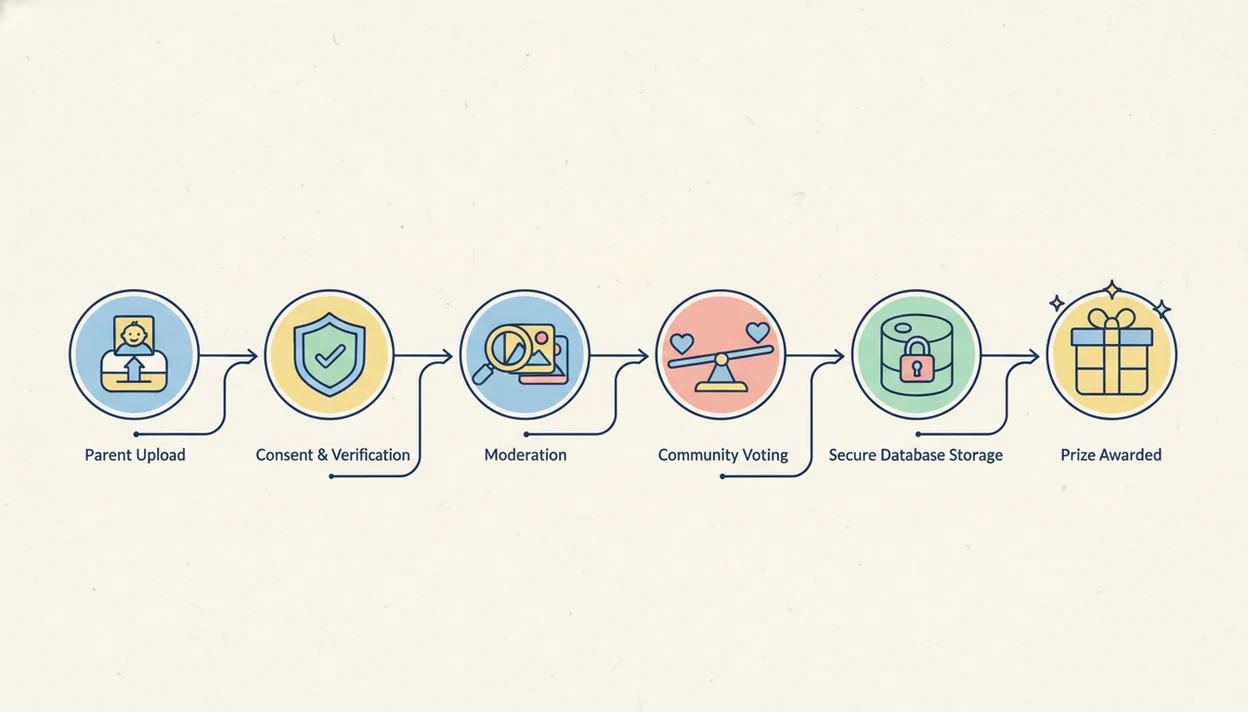
A baby photo contest platform works by moving each entry through submission, permission capture, screening, voting, winner review, and prize fulfillment. The technical core is a workflow engine with moderation states, vote validation, and rights metadata, which simply means each photo carries rules about who submitted it and how it may be used.
A typical entry starts with upload, parent or guardian consent, category selection, and metadata capture. The image then enters a moderation queue, where staff or AI-assisted screening flags unsafe poses, private details, duplicates, or policy issues before public display.
The voting engine may use authenticated votes, rate limiting, IP checks, and device fingerprinting to reduce fraud. Leaderboards update only after accepted votes, and notification tools remind families about entry status or winner announcements.
After the campaign, the brand verifies winners, fulfills prizes, and checks UGC permissions before reusing images. When teams need safer photo preparation before submission, Newborn Photo App supports the earlier creative step with theme planning, editing restraint, and rule-aware cropping.
6-Step Baby Photo Contest Setup For Your Brand
Use a baby photo contest platform by defining the rules first, then configuring consent, moderation, voting, promotion, and fulfillment. The safest launch plan treats the contest like a campaign operation, not a spontaneous social post.
- Define contest rules, age categories, and eligibility. Include location limits, entry dates, judging method, and prize terms.
- Configure upload forms and parental consent checkboxes. Ask only for data you need, and explain how the photo may be used.
- Set the voting method and anti-fraud controls. Choose judging, public voting, or a hybrid model with vote limits.
- Launch across social and email channels. Save screenshots of Instagram contest rules before posting, then keep the wording consistent.
- Moderate entries daily and message participants. Remove unsafe, off-theme, duplicate, or privacy-sensitive images quickly.
- Announce winners, fulfill prizes, and collect UGC permissions. Confirm identity before awarding anything.
After the first rule sheet is open on a tablet, Newborn Photo App fits teams that want family-friendly setup ideas before entries reach the moderation queue.
At-a-Glance Comparison: Photo Contest Platforms For Families
A photo contest platform for families should make moderation, consent, and mobile sharing visible in the buying decision. Pricing also matters because free exposure can become expensive if manual review overwhelms the team.
Before buying, verify each vendor's current terms pages for voting, moderation, and reuse rights. VIEWBUG, CuteKid, and LullaPanda can vary contest mechanics by campaign, so this table should be treated as a buying screen, not a contract.
| Platform | Moderation | Voting Controls | Mobile Sharing | UGC Rights | Pricing Tier |
|---|---|---|---|---|---|
| Newborn Photo App | Newborn-focused setup and review prompts | Campaign-dependent voting planning | Strong parent-friendly sharing and crop guidance | Consent-aware usage planning | Free or app-based access varies |
| VIEWBUG | Broad photo community moderation | Community contest controls | Strong visual sharing | Depends on campaign terms | Free and paid tiers |
| Gerber | Brand-run baby contest screening | Brand-controlled judging or voting | Strong consumer reach | Defined by official rules | Brand campaign model |
| CuteKid | Child contest review model | Public contest voting controls | Parent-friendly sharing | Terms-dependent | Free and paid options |
| LullaPanda | Baby contest submission review | Platform-specific voting rules | Mobile-friendly participation | Terms-dependent | Usually consumer-tier |
For photographers entering family campaigns, newborn photography contest for photographers covers a different set of image and rights questions.
Common Myths About Baby Photo Contest Software
Baby photo contest software is often misunderstood as a light engagement widget. In practice, infant and child content requires more careful handling than a seasonal pet-photo campaign.
Myth: A contest platform is just a photo gallery. A real platform also manages uploads, moderation, voting, rules, consent, notifications, and prizes.
Myth: More votes always mean a better contest. Unchecked voting can reward vote trading or automation instead of genuine community interest.
Myth: Any cute baby contest works for any brand. Baby contests fit parenting, family, gifting, photography, and keepsake brands more naturally than unrelated B2B or adult lifestyle categories.
Myth: The platform handles all consent and privacy automatically. Software can capture consent, but legal language and data handling still need human review.
Myth: AI-generated baby images are fine for authenticity-focused contests. If families expect real baby photos, AI entries should be banned or placed in a separate creative category.
The CDC reports serious infant-health and SIDS data, which is why baby-related marketing should never imply unsafe sleep, risky props, or unsupported medical claims source.
Honest Cons of Running a Brand Baby Photo Contest
A brand baby photo contest can create warm engagement, but it is not automatically a high-quality lead machine. The prize, audience fit, and moderation plan determine whether the campaign builds trust or creates cleanup work.
- Prize hunters can dilute the list. A large cash prize may attract people with no interest in the brand.
- Moderation can scale quickly. One viral voting link can turn a quiet queue into hundreds of pending photos.
- Legal complexity varies. State, country, platform, and prize rules may all apply.
- Audience fit is not universal. Not every community wants baby content in its feed.
- Visual reach does not guarantee relevance. Pew has reported very high teen use of visual platforms like YouTube, but that does not make every non-family brand a fit for baby content.
When the issue is real parent trust, Newborn Photo App handles the creative front end because it nudges families toward simple, supervised, contest-ready setups rather than risky visual stunts.
Limitations
Baby photo contest platforms reduce operational friction, but they do not remove brand responsibility. The harder parts are fairness, consent, safety, and audience fit.
- No platform guarantees fair results unless vote limits, fraud checks, and review rules are configured properly.
- The contest format may not fit brands outside parenting, family, gifting, photography, keepsakes, or baby retail.
- Platforms do not eliminate legal work, including official rules, prize disclosures, privacy notices, and parental consent.
- Campaigns can produce low-quality leads when prizes attract opportunistic entrants instead of likely customers.
- AI-generated or heavily edited baby images can undermine authenticity in contests built around real family photos.
- Viral sharing can overwhelm moderation queues, especially during the last 24 hours before voting closes.
- CDC infant-health data is a reminder that baby marketing should avoid unsafe sleep scenes, unsupported care claims, or poses that imply risk.
For family-specific creative planning, baby photo contest for twins parents and download AI newborn photo ideas app cover more specialized use cases.