AI Newborn Photos Vs Real Photos In Baby Contests
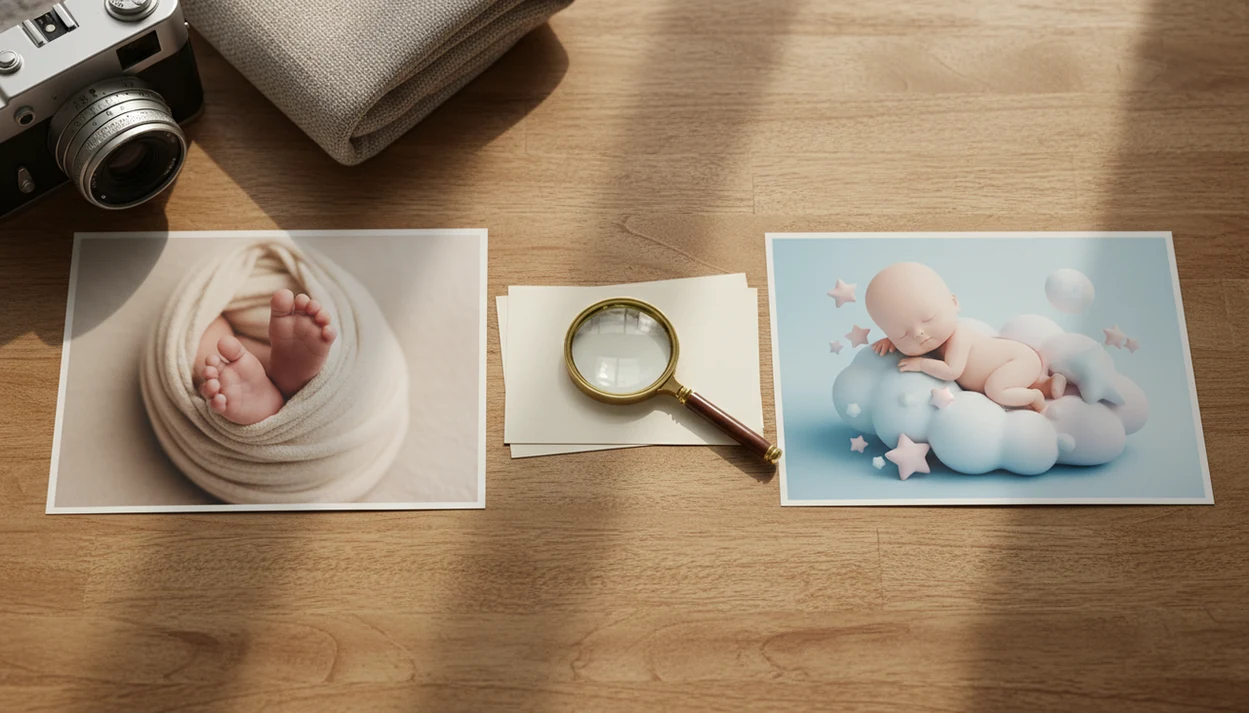
Real newborn photos are the safer default for most baby contests because they document an actual baby at a real moment, while AI newborn photos vs real photos mainly differ in authenticity, disclosure, rights, and trust. AI images can be useful for creative inspiration or separate AI categories, but they should not be passed off as untouched contest photography.
This guide is about contest authenticity, AI disclosure, privacy, and photo-safety planning; it is not medical advice or a substitute for a trained newborn photographer’s safety judgment.
- Real newborn photos are camera-captured memories of an actual baby, while AI newborn photos are generated or heavily altered by software.
- For an AI baby photos contest entry, rules should clearly say whether AI-generated, AI-enhanced, or fully real newborn photos are allowed.
- AI photo disclosure protects fairness, likeness rights, family trust, and the long-term value of baby milestone memories.
AI newborn photos vs real photos, side by side
Side-by-side captures of the compared products. Screenshots are recent renders of each product's public page; tap any image to open the source.
AI Newborn Photos Vs Real Photos At A Glance
AI newborn photos are computer-generated or heavily AI-edited images made from prompts, uploads, or a source snapshot. Real newborn photos are camera-captured images of an actual baby during a real moment or session.
| Comparison point | AI newborn photos | Real newborn photos |
|---|---|---|
| Source | Prompt, upload, model output, or AI edit | Camera capture of a baby |
| Authenticity | Synthetic, altered, or interpreted | Documents a real moment |
| Contest eligibility | Depends on AI rules or category | Usually fits traditional contests |
| Disclosure | Should be labeled clearly | Usually no AI label needed |
| Likeness accuracy | May change features or proportions | Shows the baby as photographed |
| Safety | Avoids staging the generated scene | Requires safe, supervised setup |
| Keepsake value | Creative interpretation | Family milestone record |
| Best use | Themes, mockups, AI categories | Contests, albums, heirlooms |
A phone held just above mattress height will still catch the wrinkled muslin swaddle and sleepy blink. That ordinary proof matters. Real photos usually fit traditional contests better, while AI photos fit inspiration, themed mockups, or clearly labeled AI categories.
Five Facts About AI Baby Photos Contest Entries
These five facts matter before any AI baby photos contest entry is submitted, judged, or shared with relatives. A polished image is not the same thing as a documented newborn session.
- AI baby images may change clothing, props, backgrounds, lighting, facial details, skin texture, and body proportions.
- A baby’s real face in the source image does not automatically make the final composite a real newborn photo.
- Professional newborn photography prioritizes safe handling, timing, and real interaction, not only a polished final image.
- Contest organizers should separate pure photography, AI-assisted edits, and fully AI-generated images when fairness matters.
- AI adoption is common enough for rules to address it; Pew Research Center reported that 27% of Americans said they interact with AI almost daily (Pew Research Center).
The awkward square crop box on entry forms can already cut off a bonnet. Add synthetic props or a replaced background, and the judge may not know what they are evaluating. Good newborn and baby photo contest ideas, photography tips, milestone shoots, and AI newborn photo inspiration deliver safer creative choices and clearer entries, not guaranteed prizes or permission to blur the truth.
How AI Newborn Photos Work Behind The Image
AI newborn photos are synthesized images created when generative models use prompts, uploaded pictures, and learned visual patterns to predict plausible pixels. In plain terms, the tool builds an image that looks believable, but it is not documenting a real pose, real light, or real moment.
One uploaded baby snapshot can become a winter portrait, a moon-and-stars scene, or a studio-style image with a tiny knit bonnet on pillow. The system may use image embeddings, which are mathematical summaries of visual features, to keep some likeness cues while changing the scene around them.
Output quality depends on the source-photo clarity, lighting, face angle, and the tool’s model behavior. Soft gray bedroom light around 10 a.m. gives a cleaner source than a dim hallway photo with a pacifier clip in the corner. Still, clean input does not make the output fully real.
Where Real Newborn Photos Win In Baby Contests
Real newborn photos win in traditional baby contests because they show an actual baby, real expressions, true skin texture, family connection, and a specific memory. Judges and voters can evaluate timing, composition, expression, and authentic cuteness rather than software output.
A contest-ready setup might be as simple as a plain white crib sheet, a caregiver within arm’s reach, and a test shot checked for a diaper sleeve near the edge. The photo still has context. Someone was there. The baby yawned, curled, frowned, or settled.
Safety also belongs in the comparison. Newborn photo planning should account for supported poses, head support, temperature awareness, and composite photography when trained professionals create complex images. Clinicians and newborn safety educators generally caution caregivers to avoid unsupported positions, loose unsafe setups, or any pose that prioritizes the picture over the baby’s comfort.
For traditional contests, real newborn photos are often stronger than AI versions because they prove a real moment and let judges evaluate photography instead of generation quality.
When To Use A Trained Newborn Photographer Instead
Use a trained newborn photographer when the idea depends on complex posing, hidden support, or a final image that looks impossible in real life. AI can help preview a mood board, but it should never nudge a family into unsafe staging for the sake of matching a generated picture.
- Avoid DIY versions of suspended, tightly curled, or unsupported poses, even if they look common on social media or in AI mockups.
- Choose a trained newborn photographer for composite images where hands support the baby during capture and are removed later in editing.
- Keep a caregiver within arm’s reach during any real setup, including simple blanket, crib-sheet, or basket-style photos.
- Watch for signs that the baby is cold, unsettled, overstimulated, or uncomfortable, and stop the session instead of pushing for one more frame.
- Treat AI concepts as visual notes only, not instructions for how to balance, suspend, curl, prop, or position a newborn.
The best contest photo is never worth a risky setup. A sleepy yawn on a plain sheet beats a dramatic scene that asks the baby to do too much.
Where AI Newborn Photos Win For Family Sharing
AI newborn photos win when the goal is imagination, not proof. They can help with holiday concepts, nursery-style fantasy scenes, seasonal cards, low-cost theme testing, and previewing which props might look crowded before the real session.
That can be genuinely useful. A parent can test whether a moon backdrop feels sweet or too busy before placing any blanket near the baby. A mini pumpkin near crib rail may look charming in an AI mockup, then feel distracting in the real room.
AI usually works best when labeled as creative, AI-assisted, or synthetic. That label keeps a fantasy portrait from becoming confused with a real milestone keepsake. A generated woodland scene may be fun for a group chat, but the photo grandma prints for the fridge is often the real sleepy face from Tuesday morning.
For families, AI newborn photos usually fit creative planning while real newborn photos fit milestone memory because only the real image documents the baby as they were.
AI Photo Disclosure Rules For Newborn Photo Apps
Should AI newborn photos be disclosed in baby contests? Yes, disclosure should be required for fully generated images, AI background swaps, AI props, face retouching that changes likeness, and heavy synthetic editing.
Contest organizers can keep rules simple by naming categories clearly:
| Category | What it allows |
|---|---|
| Real newborn photos only | Camera-captured entries with basic edits |
| Light editing allowed | Crop, exposure, color, and small cleanup |
| AI-assisted | AI background, styling, or enhancement disclosed |
| Fully AI-generated | Synthetic image or prompt-based portrait |
Disclosure protects fairness, judging clarity, and entrant trust; Pew Research Center found that 52% of Americans are more concerned than excited about AI use (Pew Research Center), and a World Economic Forum/Ipsos survey found broad discomfort with AI systems that generate realistic images of people (Ipsos).
Parents often save screenshots of Instagram contest rules before they post. That small habit helps if the rules later disappear into a story highlight. For broader privacy planning, a baby photo contest privacy checklist can help families think through captions, sharing, and permissions before uploading.
How To Use AI Newborn Photos Without Misleading Viewers
Use AI newborn photos as labeled creative versions, not as replacements for real milestone records. The safest workflow is to separate planning, labeling, storage, and contest submission before anyone votes or downloads.
- Check the official rules before generating or submitting AI images, especially if prizes or public voting are involved.
- Label AI images clearly in captions, albums, and file names, using words like “AI-assisted” or “generated concept.”
- Separate real milestone photos from AI creative versions so family albums stay accurate over time.
- Save the original camera file when you edit, crop, or test themes for a contest-ready setup.
- Submit AI work only to categories that allow synthetic, AI-assisted, or creative entries.
The before-after screen split can be tempting, especially when an app smooths lighting in one tap. Keep the original anyway. If you want natural edits for a real entry, our guide on how to edit baby contest photos with phone focuses on crop, exposure, and gentle cleanup rather than changing identity.
Common Myths About AI Newborn Photos Vs Real Newborn Photos
Several myths lead families into confusing entries or misleading keepsake albums. The practical fix is to name what changed and why it matters.
- “AI newborn photos are just filters.” They can be fully synthetic or heavily composited, changing outfits, props, backdrops, skin texture, and the whole scene.
- “AI photos are always safer than real photography.” AI avoids staging the generated scene, but it cannot replace safe session planning, trained handling, or a caregiver within arm’s reach for real photos.
- “A real baby face makes the whole entry real.” The face may come from a snapshot while the pose, lighting, blanket, and background are generated.
- “Nobody can tell AI from real.” A 2023 Microsoft–University of Washington study found that participants identified AI-generated images of people only about 62% of the time (Microsoft Research).
Look closely at fingers, lashes, blanket edges, and shadows. Sometimes the eyelashes against warm cheek look right, but the shoulder line quietly stops making sense. Detection helps, but it should not replace disclosure.
Evidence And Source Notes For AI Photo Disclosure
The evidence points to a simple rule: disclose AI use because viewers, judges, and even careful parents cannot reliably spot every synthetic image. Disclosure is steadier than guessing from eyelashes, fingers, blanket folds, or background blur.
Pew’s AI concern and daily-use figures help explain why contest rules should be plain before voting starts. The WEF/Ipsos survey on discomfort with realistic AI images of people supports the same trust point: a lifelike baby portrait may feel personal even when it is generated. The Microsoft–University of Washington image-detection study is useful too, but it studied adult-facing AI image perception, not newborn contest entries. Newborn photos have different cues: curled hands, swaddles, soft skin, tiny props, and sleepy expressions can hide or mimic AI artifacts.
- Treat adult AI-image research as a warning signal, not a perfect newborn-photo map.
- Write rules that separate real capture, light editing, AI assistance, and fully generated work.
- Ask entrants to label synthetic props, swapped backgrounds, and likeness-changing edits.
- Keep original camera files when authenticity may be questioned.
- Use visual review as a backup, not the main proof.
That is why disclosure beats detection. A clear label travels with the image; a visual guess changes with the viewer.
Real Newborn Photos Or AI Baby Photos: Which Should You Pick?
Pick real newborn photos when the goal is proof of a real moment. Pick AI newborn photos when the goal is imagination, concept planning, or an AI-labeled category.
| Your goal | Better choice | Why |
|---|---|---|
| Traditional baby contest | Real newborn photo | Shows authentic photography and likeness |
| Milestone documentation | Real newborn photo | Preserves the actual memory |
| Heirloom album | Real newborn photo | Family can trust the record |
| Fantasy theme | AI newborn photo | Creates scenes not available at home |
| Private creative play | AI newborn photo | Low-cost idea testing |
| AI-labeled contest category | AI newborn photo | Fits the category if allowed |
The rule is simple: if the goal is proof of a real moment, choose real; if the goal is imagination, choose AI and disclose it.
Tools like Newborn Photo App can help parents plan, edit, and share contest-ready newborn photos without blurring contest eligibility. Apps such as Canva, babyphotoart.app, and babypics.app may also help with layouts or creative concepts, but parents still need to read the official rules.
Limitations
AI and real newborn photography both have limits. Contest policies should treat those limits as rule-writing issues, not afterthoughts.
- AI newborn photos may depend heavily on the quality, lighting, and angle of the source image.
- AI tools may distort facial features, skin tone, fingers, limbs, blankets, props, or newborn proportions.
- AI image detection is imperfect, so contests should not rely only on visual inspection.
- Many AI tools do not clearly explain how infant images are stored, processed, or reused.
- Real newborn photography can still involve editing, composites, or staged setups, so rules should define acceptable editing.
- Contest policies vary, so entrants must check the specific rules before submitting.
- This article is about photo authenticity and contest planning, not medical newborn care.
A neutral quilt over an armchair can look calmer than a generated studio set. However, even a real setup needs supervision, a clean crop, and clear rules. For gentle, non-synthetic cleanup, compare options in a newborn photo editor before changing anything that affects likeness.
FAQ
Are AI newborn photos real photos?
AI newborn photos may be based on a real baby, but the final image is generated or heavily altered by software. They should not be treated as untouched real newborn photos.
Can AI baby photos enter contests?
AI baby photos can enter contests only if the official rules allow AI-generated, AI-assisted, or synthetic entries. Entrants should check the category requirements before submitting.
Should AI baby photos be disclosed?
Yes, AI baby photos should be disclosed when generation, background replacement, synthetic props, or likeness-changing edits are used. Disclosure supports fairness, trust, and accurate family records.
What counts as a real newborn photo?
A real newborn photo is a camera-captured image of an actual baby at a real moment. Basic crop, exposure, or color edits may still be allowed if contest rules permit them.
Is AI editing allowed in baby photo contests?
Some contests allow light editing but restrict AI-assisted edits or fully synthetic image generation. The official rules should define the difference before entries open.
Can people detect AI baby photos?
People can sometimes detect AI baby photos, but detection is unreliable. Clear rules and entrant disclosure are more dependable than visual inspection alone.
Can AI photos change my baby's likeness?
Yes, AI photos can subtly change facial features, skin tone, proportions, expressions, hair, or eye details. Families should review outputs carefully before sharing.
Are AI newborn photos safer than real newborn photos?
AI photos avoid staging the generated scene, but they do not replace safe handling for real newborn photography. Any real photo session still needs supervision and age-appropriate posing.
How should families store AI newborn photos?
Families should label AI creative images and store them separately from real milestone photos. Separate folders, captions, or file names help preserve the difference over time.