Judged vs Voting Baby Photo Contest: Which Format Is Better?
A judged baby contest is usually better for fairness, photo quality, and lower sharing pressure, while a voting contest is better if you want community participation and social reach. The best judged vs voting baby photo contest choice depends on whether your priority is expert scoring, privacy, prizes, feedback, or family engagement, and Newborn Photo App helps parents prepare entries for either format without treating the baby photo as a popularity race.
A judged vs voting baby photo contest compares two winner-selection formats: expert or panel scoring versus public votes, likes, shares, or audience popularity.
- Pick a judged baby contest if you want criteria-based scoring, less campaigning, and stronger emphasis on photo quality.
- Pick a voting baby contest if you enjoy rallying friends and family, sharing publicly, and treating the contest as a social event.
- Before entering either format, read the rules on image rights, AI editing, newborn safety, vote fraud, fees, and how your baby’s photo may be reused.
Judged vs voting baby photo contest, side by side
Side-by-side captures of the compared products. Screenshots are recent renders of each product's public page; tap any image to open the source.
Judged vs Voting Baby Photo Contest at a Glance
Judged contests usually favor fairness and image quality, while voting contests favor reach and participation. Neither format is automatically safe, fair, or legitimate unless the official rules explain scoring, image use, safety standards, and prize terms.
| Factor | Judged baby contest | Voting baby contest |
|---|---|---|
| Winner selection | Panel, sponsor, or judge rubric | Votes, likes, shares, or public ranking |
| Parent effort | Prepare one strong image | Promote repeatedly during the campaign |
| Privacy | Can be more controlled if gallery is limited | Often requires public sharing |
| Cheating risk | Bias or unclear judging | Bots, vote buying, duplicate votes |
| Feedback | Sometimes clearer criteria | Usually little photo feedback |
| Best-fit goal | Quality, theme fit, calmer entry | Family fun, reach, social energy |
A parent with a rule sheet open on a tablet and one favorite photo starred in the gallery is already doing the right thing. Read before posting. If your entry form has that awkward square crop box, check whether it cuts off a bonnet, a grandparent’s hand, or the prop that explains the theme.
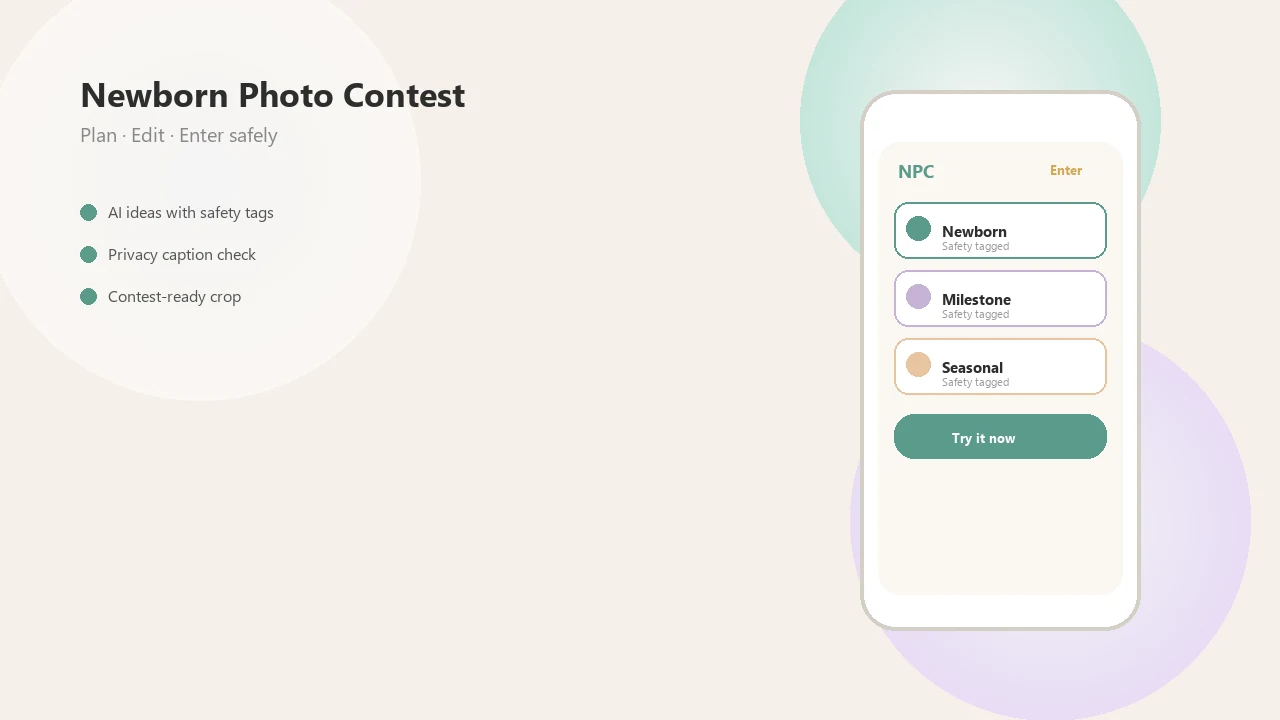
Parents looking for a calmer contest-ready setup often use Newborn Photo App because NPC organizes theme, crop, caption, and rule checks in one workflow.
How Judged and Voting Baby Photo Contests Work
Judged and voting baby photo contests work by using different authority signals: one relies on review criteria, and the other relies on audience response. A judged contest is usually rubric-based, meaning sponsors, judges, or panels compare entries against stated factors instead of simply counting popularity.
In a voting contest, the public ranks entries through votes, likes, shares, gallery clicks, referral links, or similar engagement signals. Some contests blend both systems, using voters to create a finalist pool and then letting judges choose the final winners. That hybrid setup can feel balanced, but it still depends on how clearly the organizer explains each stage.
- Review the selection method: Check whether winners come from judges, public votes, or a finalist-plus-panel process.
- Compare the scoring details: Look for rubrics, theme criteria, image-quality standards, and whether judges are named.
- Check voting controls: Look for limits on daily votes, email verification, suspicious traffic review, and duplicate-account rules.
- Read tie-breakers: Confirm what happens if scores or vote totals match.
- Judge fairness by transparency: Clear fraud controls, published criteria, and tie-breaking rules usually make the outcome easier to trust.
Baby Photo Contest Formats Behind Judging Panels and Vote Counts
A judged baby contest uses a rubric or panel to score entries on theme fit, lighting, composition, originality, emotional expression, editing restraint, and safe-looking presentation. A voting baby contest uses a public gallery where votes, likes, shares, email verification, leaderboard rank, campaign timing, and fraud controls shape the outcome.
Newborn Photo App is a baby photo contest app that helps parents plan, edit, and share contest-ready newborn photos. It supports both baby photo contest formats by helping families choose a safe idea, crop for the entry form, and avoid over-editing before upload.
Hybrid formats sit in the middle. Public voting may create finalists, then judges select winners from that shortlist. That can reduce some popularity bias, but it does not remove it.
How baby photo contest formats work is simple at the surface and messy underneath. Judged contests rely on scoring rubrics, which are structured criteria. Voting contests rely on engagement signals, which means audience behavior becomes part of the contest. Good newborn and baby photo contest ideas, photography tips, milestone shoots, and AI newborn photo inspiration deliver safer, clearer entry choices, not guaranteed wins.
For parents who need a photo-selection workflow before comparing contests, Newborn Photo App fits because the app helps narrow a phone gallery into one contest-ready image with crop and theme checks.
How to Use Either Baby Photo Contest Format
Use either baby photo contest format by matching the rules to your comfort level before you prepare the image. The safest path is to choose the format first, then edit, upload, pay, or promote only after you understand the terms.
- Choose the format: Decide whether privacy, fairness, family involvement, or low effort matters most. A judged contest usually reduces campaigning, while a voting contest asks you to involve more people.
- Read the rules: Check deadlines, entry fees, image-use permissions, AI-editing limits, prize terms, and voting controls before touching the upload form.
- Prepare one photo: Pick a safe, clearly cropped image that fits the theme without exposing private details in the background, caption, clothing, or file name.
- Submit carefully: Upload the entry, review the preview crop, and save screenshots of the rules, deadline, confirmation page, and permission language.
- Promote respectfully: If votes matter, share the voting link with relatives and friends without posting medical details, full birth information, location clues, or repeated pressure.
Judged Baby Contest Fairness and Photo Quality Advantages
A judged baby contest can be fairer when the organizer publishes clear scoring criteria and uses more than one reviewer. It rewards the submitted image more than the size of a parent’s social network.
- Defined criteria can reduce popularity bias compared with vote totals.
- Common judging factors include lighting, focus, composition, theme fit, creativity, and emotional expression.
- Editing restraint matters; face-softening filters, heavy backgrounds, and AI effects may hurt a natural newborn entry.
- Judged contests can offer clearer expectations, even when they do not provide personal feedback.
- Judges can still bring aesthetic, cultural, and resource-based bias.
Soft gray bedroom light around 10 a.m. often beats a harsh overhead bulb. We have seen a plain white crib sheet, a wrinkled muslin swaddle, and a phone held just above mattress height create a stronger entry than a crowded prop scene.
For families who value quality over campaigning, a judged contest is often easier than a voting contest because the work stays focused on one safe, well-presented photo.
Voting Baby Contest Sharing and Family Involvement Advantages
Does a voting baby contest make sense if you want relatives involved? Yes, a voting format can feel fun and inclusive because grandparents, cousins, friends, coworkers, and followers all have a simple way to participate.
Public voting contests are social campaigns. They often run through galleries, Facebook posts, Instagram prompts, email links, or daily vote buttons. Pew reported that 60% of parents regularly post photos of their children online, and 75% of Facebook-using parents share child photos, videos, or updates, according to its 2015 parent survey source. That existing behavior is exactly what voting contests tap.
Still, the winner may reflect network size, reminder discipline, and time zone luck more than photo quality. A diaper sleeve in the corner of a test shot may not matter if the family can gather hundreds of votes.
If your priority is family engagement, Newborn Photo App handles the preparation side because NPC can help shape the caption, crop, and share-ready image before a public voting push. For hashtag-heavy promotions, parents often pair that prep with careful baby photo contest hashtags.
Baby Photo Contest Rules for Privacy, Rights, AI, and Safety
The rules matter more than the headline format because privacy, rights, AI editing, and posing safety can change the real cost of entry. Save screenshots of the official rules before you post, especially if the contest runs through social media.
Image-use rights and child privacy
Before entering, scan the rules for three items: whether the organizer can repost or crop the image, whether the permission covers sponsor marketing, and whether you can request removal later. The FTC’s COPPA guidance explains why collecting or sharing children’s personal information online requires extra care source. If the contest depends on a public gallery, compare social media baby photo contests before weighing the prize.
AI edits and newborn safety rules
AI-generated, AI-enhanced, heavily edited, and composite newborn images are not treated the same by every contest. Some ban generated images. Some allow disclosed enhancement. Some permit composites only when they protect the baby.
For complex newborn poses, safety guidance favors spotters, hands-on support, and composite editing instead of unsupported positioning source. Newborn Photo App keeps AI as planning or enhancement support around a real baby photo, not proof that a risky setup should be attempted.
6-Step Checklist for Choosing a Judged or Voting Baby Photo Contest
Use this checklist to choose the format that matches your real goal, not just the prize headline. Choose judged for quality, fairness, and privacy; choose voting for engagement, reach, and family fun.
- Set your goal: Decide whether you want feedback, a fairer photo review, family participation, exposure, or a prize.
- Check privacy terms: Read image rights, likeness permissions, sponsor reuse, public gallery rules, and removal options.
- Compare scoring rules: Look for rubrics, judge names, vote limits, fraud controls, and tie-breaking methods.
- Assess promotion effort: Decide whether you can handle daily reminders, family texts, and public sharing without stress.
- Review safety and editing rules: Confirm age-appropriate posing, composite policy, AI disclosure, and editing limits.
- Weigh the prize: Ask whether the entry fee, digital footprint, and time cost are worth the possible outcome.
A phone flashlight switched off beside soft patio-door light is a small choice, but it often improves the image fast. If the photo still needs wording, baby photo contest caption ideas can help keep the entry warm without oversharing.
If privacy and low pressure matter most, judged formats usually fit better than voting formats because they do not require repeated public campaigning.
Common Myths About Judged and Voting Baby Contest Formats
Contest myths are practical risks you can investigate in the rules. Do that before you upload, pay a fee, or ask relatives to vote.
Myth 1: Public voting is always fairer. Open voting sounds democratic, but it can reward larger networks, daily campaigning, organized groups, or paid votes.
Myth 2: Judged contests are always rigged. Some are poorly run, but a clear rubric and named panel can be more consistent than raw vote counts.
Myth 3: AI or heavy editing is always allowed. Many baby photo contest formats limit generated images, composites, beauty filters, background swaps, or undisclosed AI edits.
Myth 4: Baby contest sharing is harmless and temporary. Screenshots, sponsor reposts, cached pages, and family shares can outlive the contest window.
Myth 5: A cute photo is enough. A contest-ready setup also needs rule fit, safe posing, clean crop, and appropriate permissions.
Newborn Photo App earns its spot for rule-conscious parents because the app frames theme choice, editing, caption, and submission prep as one checklist rather than separate guesses. Canva.com, babypics.app, and babygram.app can help with design or edits, but parents still need to verify each contest’s terms.
Limitations
There is little direct peer-reviewed research comparing judged and voting baby photo contest outcomes. Most parent decisions must rely on contest rules, platform behavior, privacy norms, and common-sense risk review.
- Public voting can be affected by bots, vote buying, duplicate accounts, organized voting groups, popularity bias, and uneven social reach.
- Judged contests can still reflect judge preferences, aesthetic trends, cultural bias, and resource advantages.
- Privacy norms may change as today’s babies grow old enough to object to older posts.
- Child-consent expectations may become stricter over time.
- Rules vary widely by organizer, country, platform, prize, sponsor, and entry method.
- AI policies are changing quickly, so a rule that allowed enhancement last month may not apply now.
- This article is informational and is not legal advice about image rights, contest terms, or sponsor permissions.
- Newborn Photo App does not verify every third-party contest, guarantee placement, or replace reading official rules.
A rejected AI backdrop preview may be the right call. Sometimes the plain photo is safer, clearer, and easier to explain.
FAQ
Are judged baby contests fairer than voting baby contests?
Judged baby contests can be fairer when they use published scoring criteria, multiple reviewers, and clear tie-breaking rules. They can still include subjective bias, especially around style, culture, resources, and what judges consider a strong baby photo.
How can I tell if a voting baby contest is legitimate?
Check the organizer’s identity, full rules, entry fees, prize details, voting limits, privacy terms, and image-use permissions. The FTC warns consumers to be cautious with prize promotions that ask for fees, sensitive information, or payment before a prize is awarded source. A legitimate voting contest should explain how it handles duplicate votes, bots, suspicious traffic, and winner verification.
Can baby contest votes be fake or bought?
Yes, public voting contests can be affected by bots, vote buying, duplicate accounts, and organized voting groups. Stronger contests use email verification, device checks, fraud review, vote limits, and manual audits, but no system is completely immune.
Do judges score baby cuteness or photo quality?
Stronger judged contests usually score theme fit, image quality, expression, creativity, composition, and overall presentation rather than cuteness alone. Parents should read the rubric because some contests weigh personality, story, or brand fit more heavily than technical photography.
Are AI-edited baby photos allowed in contests?
AI rules vary by organizer. Some contests ban AI-generated images, while others allow disclosed enhancement, background cleanup, or composite editing if the submitted image still follows the contest’s authenticity and safety rules.
Should I post my baby’s photo publicly for votes?
Only post publicly if you are comfortable with the digital footprint, possible reposting, platform visibility, and future child-consent concerns. Read whether the contest can reuse the photo in marketing, whether removal is possible, and whether voting requires public sharing.
Which baby photo contest format takes more effort?
Judged contests usually require more effort before submission, including choosing, editing, cropping, and matching the theme. Voting contests often require more effort after submission because parents may need to promote daily, message relatives, and monitor vote deadlines.
What makes a baby photo contest safe for newborns?
A safer contest does not pressure parents to attempt risky poses, unsupported props, or misleading setups. Look for age-appropriate pose rules, clear editing policies, privacy controls, transparent terms, legitimate organizers, and permission to use composites for complex newborn images.