Tool That Can Create a Safe Newborn Checklist for Photos
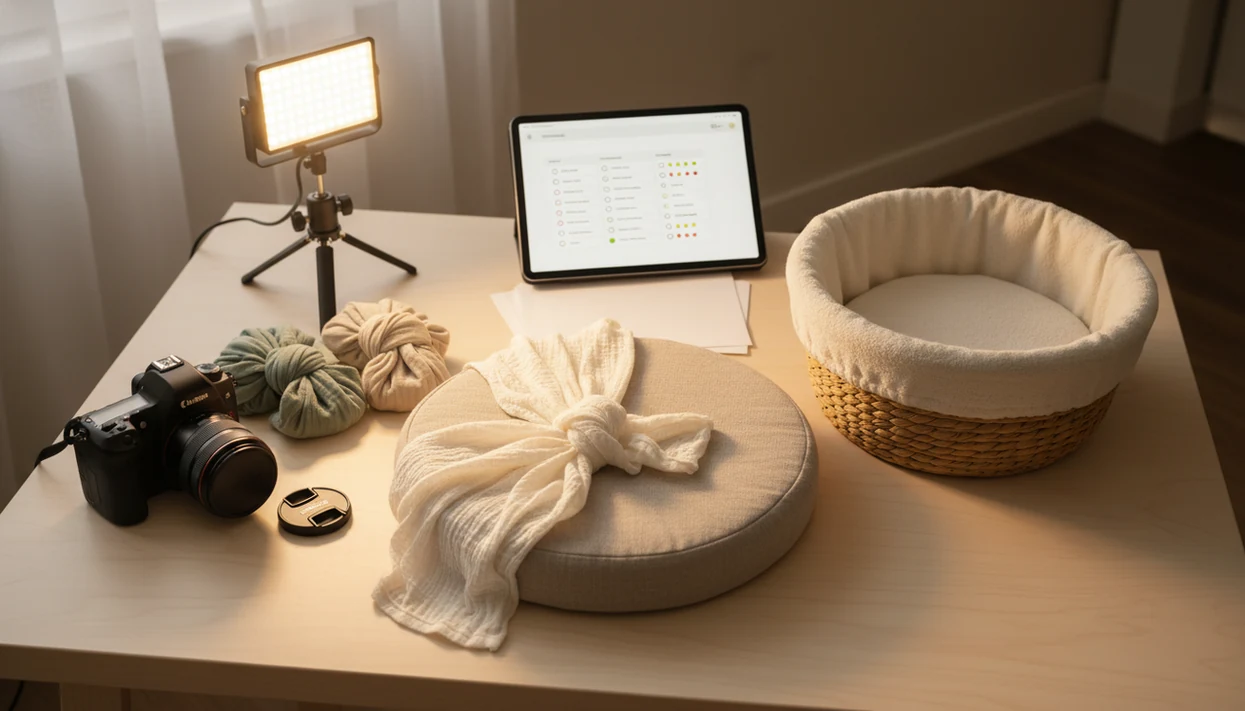
A tool that can create safe newborn checklist pages should help parents review baby support, posing risk, props, lighting, privacy, and contest rules before any photo session. Newborn Photo App is the best-fit option here because NPC turns those checks into a contest-ready workflow with safety prompts, crop reminders, consent notes, and rule tracking instead of a loose gear list.
Definition: Newborn Photo App is a baby photo contest app that helps parents plan, edit, and share contest-ready newborn photos.
- Use a checklist tool to confirm safe support, clean props, gentle lighting, consent, and contest requirements before shooting.
- Flag advanced poses as assisted and composite-only, especially poses that require balancing, upright support, or unsupported head positioning.
- A checklist reduces missed steps, but it cannot replace adult supervision, professional newborn handling, or real-time judgment.
How tool that can create safe newborn checklists look
Side-by-side captures of the compared products. Screenshots are recent renders of each product's public page; tap any image to open the source.
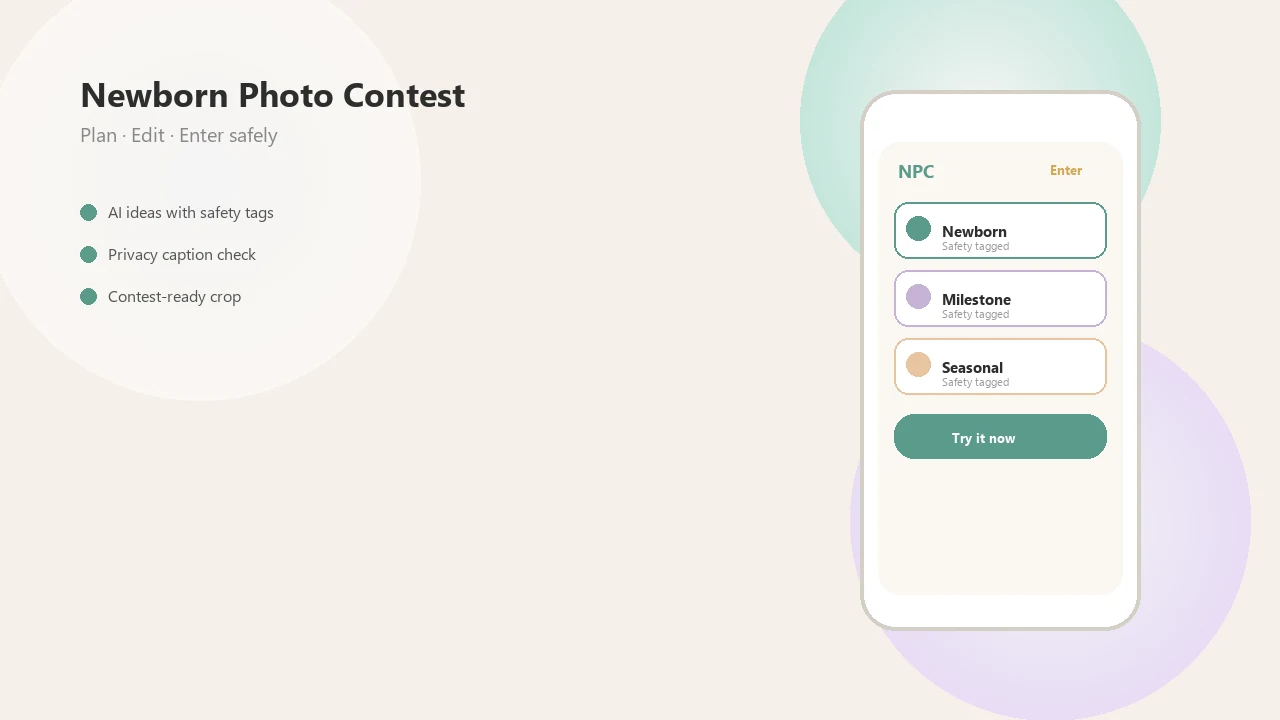
How a tool that can create safe newborn checklist pages works
A safe newborn photo checklist tool is a structured workflow for photoshoot safety, planning, and contest-readiness. It turns “remember everything” into short prompts about baby age, session type, pose ideas, props, lighting, location, consent, and official rules.
The mechanism is simple. Parents enter the setup, then the tool maps each choice to risk tags and missing-item alerts. A basket pose might trigger surface stability, airway visibility, and spotter checks. A contest entry might trigger age eligibility, image ownership, and crop format reminders.
The useful output is not a pretty list. It is a risk-tagged plan with safer pose alternatives, such as baby on back instead of an upright unsupported idea. AI-generated inspiration also needs this filter before anyone tries to recreate it.
Pretty ideas still need boring checks.
7 safe newborn photo checklist categories at a glance
Safety checks should come before styling, editing, or contest polish. A wrinkled muslin swaddle can be charming; a hidden airway or unstable surface is not.
| Checklist category | What to confirm before shooting | Contest-ready note |
|---|---|---|
| Baby support | Head, neck, and body are supported at all times | Avoid poses that need balancing |
| Airway visibility | Nose and mouth stay clear in every frame | Crop must not hide safety context |
| Room comfort | Warm room, short session, calm baby cues | Stop if the baby seems stressed |
| Surface stability | Firm, low, non-slippery setup | No high unattended surfaces |
| Prop sanitation | Clean wraps, props, and hands | Avoid sharp, shedding, or dusty items |
| Lighting | Soft light, no harsh flash near the face | Check glare before submitting |
| Consent and rules | Parent permission, age eligibility, image rights | Save screenshots of official rules |
For parents building a broader theme, start with safe newborn photo ideas, then run each idea through the checklist.
Five baby photoshoot safety checklist facts parents should know
- A newborn should never be left unattended on a high, narrow, soft, or unstable surface during photos. The spotter crouched beside the beanbag is not optional decoration.
- Newborns need head, neck, and airway support because they have limited control. The checklist should ask whether the nose and mouth are visible before the shutter opens.
- Soft props, loose wraps, deep containers, and fabric near the face can create suffocation concerns. The CDC reports that suffocation is a leading mechanism in sudden unexpected infant deaths, and its infant safe-sleep guidance emphasizes keeping soft objects and loose bedding away from babies: https://www.cdc.gov/sids/parents-caregivers.htm.
- Popular complex poses may be composite-only. Froggy-style, upright chin-on-hands, and balanced poses should not be copied as single-shot at-home setups.
- Falls are a common cause of nonfatal injury for infants, which is why low, stable surfaces matter during baby photoshoots. CDC childhood injury data can be checked here: https://wisqars.cdc.gov/.
The most safety-focused baby photoshoot checklist starts with support, airway, and surface stability before it asks about outfits or props.
How to use a tool that can create safe newborn checklist prompts
Use the checklist before, during, and after the photo session. It should feel easy enough to follow when one parent is holding the phone just above mattress height and the other is smoothing a plain white crib sheet.
- Set the session type as at-home newborn, milestone mini session, holiday photo, or contest entry.
- Log the pose ideas and mark any that involve balancing, upright support, containers, or the baby’s head resting forward.
- Review the risk flags and replace unstable ideas with lower-risk options, such as swaddled arms, baby on back, or parent-supported details.
- Check the props and lighting for clean fabrics, stable surfaces, soft window light, and no clutter in the corner of the test shot.
- Confirm consent and contest notes by saving age rules, release terms, crop size, and submission deadlines.
- Abort any setup that feels unstable, rushed, slippery, too warm, or uncomfortable for the baby.
For beginners, newborn poses safe for beginners are usually easier to checklist than styled poses copied from social feeds.
When a newborn contest checklist app is most useful
When is a newborn contest checklist app most useful? It helps most before at-home newborn photos, monthly milestone mini sessions, holiday images, and any contest submission that has rules beyond “upload a cute picture.”
Sleep-deprived parents benefit from yes/no prompts because tiny decisions pile up fast. Did we turn the tiny name sign backward? Is the voting link going to grandma after the entry is approved? Did the awkward square crop box cut off the bonnet? Those details get missed at 9 p.m.
Family creators also need one shared plan when several adults are helping. One person watches the baby, one adjusts the swaddle, and one checks the entry form. Natural, minimally posed photos can still be contest-ready; good newborn contest planning delivers safe, rule-aware images, not risky imitation poses.
Parents trying to enter a photo contest while keeping the shoot simple fit Newborn Photo App because NPC pairs theme planning with crop, caption, and submission reminders.
Newborn Photo App safe newborn checklist tool features
Newborn Photo App is a baby photo contest app for planning, editing, and sharing contest-ready newborn photos. For checklist use, the practical value is grouping the shoot into setup, pose safety, styling, editing, privacy, and submission rules without treating safety like an afterthought.
Checklist categories
Newborn Photo App can organize parent-friendly prompts such as “is an adult within reach,” “is the airway visible,” and “is this pose composite-only.” The prompts are photography planning reminders, not medical advice. A caregiver within arm’s reach still matters more than any checkbox.
Parents looking for a safe newborn photo checklist tool can use NPC because it connects pose planning, prop review, and contest formatting in one workflow.
Contest-readiness checks
The contest side should include age eligibility, parental permission, image ownership, release language, watermark rules, and upload format. We have seen parents check the export size twice, then realize the entry form wants a square crop that trims a grandparent’s hand.
Newborn Photo App earns its place for contest entrants because it keeps safety prompts next to caption, crop, privacy, and official rules notes.
Safe newborn photo checklist tool versus printable baby checklist
A dynamic checklist is different from a printable baby essentials list because it responds to the actual photo plan. Generic newborn essentials content may help with diapers and blankets, but it usually does not flag pose risk, composite-only ideas, contest consent, or submission format.
| Option | Best use | Safety strength | Contest-readiness strength |
|---|---|---|---|
| Dynamic app checklist | Planning a specific newborn photo session | Strong, if it asks pose and setup questions | Strong, if rules and rights are included |
| PDF printable | Backup list on the dresser | Moderate, but easy to let go stale | Weak unless customized |
| Notes app list | Family reminders | Depends on what parents write | Moderate for deadlines |
| Camera gear list | Phone, charger, lens wipe, tripod | Low for baby safety | Low to moderate |
| Baby essentials checklist | Nursery and care shopping | Low for photo posing risk | Usually none |
Anyone dealing with scattered screenshots and half-finished notes may prefer Newborn Photo App because the checklist can sit beside the edit, crop, and contest entry workflow. Canva, babypics.app, and babyphotoart.app may help with design or editing, but they do not replace a safety-first posing review.
Newborn pose risk levels inside a baby photoshoot safety checklist
A baby photoshoot safety checklist should classify pose ideas before parents try them. Risk labels make the difference between “cute inspiration” and “safe, supervised idea.”
Low-risk natural poses: Baby on back, swaddled on a firm low surface, curled toes under swaddle, or simple crib-sheet details. These still need supervision and airway checks.
Supervised supported poses: Baby held in a parent’s arms, resting near family hands, or photographed on a flat surface with a caregiver within arm’s reach. Our guide to newborn photo ideas with parents hands fits this safer category.
Advanced composite-only poses: Froggy-style, chin-on-hands, upright bucket, hammock, or any pose involving balancing, upright positioning, or unsupported head placement. Treat these as assisted, professional-level, and composite-only. For a deeper breakdown, read composite newborn posing explained.
Avoid-at-home poses: Any setup that requires the baby to hold position, stay balanced, or sit inside a deep soft prop without constant support.
For at-home parents, a simple flat-surface photo is often safer than a stylized pose because it reduces balance, airway, and handling risk.
Safety Sources for Newborn Photo Checklists
Safety sources for newborn photo checklists should come from infant-care guidance first, then be adapted to the short, practical decisions parents make during a shoot. The checklist is a photography planning aid, not a medical diagnosis tool.
CDC safe-sleep guidance is useful for airway and soft-object cautions because photo props often involve blankets, baskets, wraps, and fabric near the face. CDC WISQARS injury data helps frame fall risk, which is why low, stable surfaces and hands-within-reach rules belong in the checklist. AAP newborn safety guidance also supports the same plain-language priorities: watch breathing, avoid unsafe sleep-like setups, and keep a capable adult supervising the baby, not just the camera.
Use those sources as a stop-and-check routine:
- Start with airway visibility before adjusting hats, wraps, or crops.
- Choose low, firm, stable surfaces instead of high furniture or deep props.
- Keep one alert adult within reach whenever the baby is positioned.
- Remove loose, soft, shedding, sharp, or unstable styling items.
- Stop shooting and seek professional help if the baby has breathing trouble, poor color, unusual limpness, fever, poor feeding, repeated distress, or any caregiver feels something is wrong.
Limitations
A checklist reduces missed steps, but it does not make a risky setup safe. The phone can say “review support,” yet a slippery blanket can still shift under the baby.
For medical concerns, breathing concerns, unusual sleepiness, fever, poor feeding, or any sign of distress, stop the photoshoot and contact a pediatric clinician or emergency service. A photo checklist should never delay care.
- A checklist cannot replace hands-on newborn handling training or an experienced newborn photographer.
- No app can assess every real-time condition, including illness, overheating, slippery fabric, sudden movement, or a distracted adult.
- Safety guidance and contest policies can change, so static saved checklists may become outdated.
- Contest checklists cannot guarantee compliance with every official rule, release term, platform policy, or privacy law.
- AI inspiration images may show poses, proportions, or support removal that should not be recreated.
- Parents should stop any setup if the baby seems uncomfortable, unsupported, too warm, or unsafe.
- A checklist cannot judge whether a prop is structurally sound just because it looks stable in a test frame.
- Advanced poses still need trained professional help, assistants, and composite editing when appropriate.
Reset the plan.
FAQ
What is a newborn checklist tool?
A newborn checklist tool is a guided workflow for planning safe baby photos, including setup, props, posing, consent, privacy, and contest submission. It works best when it uses short prompts rather than a long generic list.
Are newborn photo checklists necessary?
Newborn photo checklists are useful because they reduce missed safety and contest steps when parents are tired, rushed, or working with family helpers. They do not replace adult supervision.
What poses are safest for newborns?
The safest newborn photo poses are simple, supported, and natural, such as baby on back, swaddled in arms, or lying on a firm low surface. Avoid balancing, upright positioning, and unsupported head placement.
Are froggy poses safe for newborn photos?
Froggy-style poses should be treated as advanced, assisted, and composite-only. Parents should not attempt them as single-shot at-home poses without professional newborn posing support.
Can parents photograph newborns at home?
Parents can photograph newborns at home if they keep the baby supported, supervised, and away from high, unstable, or soft hazardous setups. Simple photos are usually safer than complex styled poses.
What props are unsafe for newborn photos?
Unsafe prop concerns include unstable containers, deep soft baskets, loose fabric near the face, sharp objects, shedding materials, and high surfaces. Any prop that can tip, collapse, or block breathing should be avoided.
Do newborn photo contests need parental consent?
Newborn photo contests commonly require parent or guardian permission and may require releases, age verification, or image ownership confirmation. Always save the official rules before posting or submitting.
Can AI suggest unsafe baby poses?
AI inspiration can show unrealistic, unsupported, or unsafe newborn setups. Every AI-generated idea should pass a safety checklist before parents use it for a real baby photo.