
Composite Newborn Posing Explained for Parents
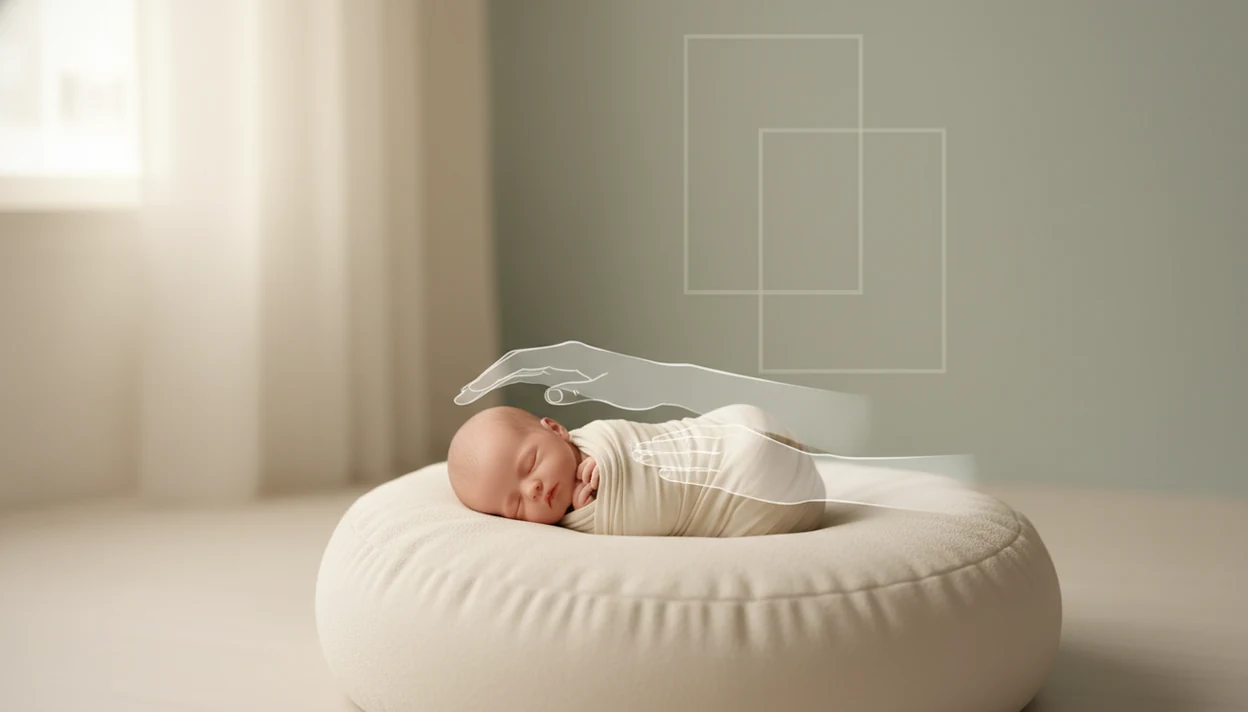
Composite newborn posing explained simply: it is a safety-first editing method where two or more supported newborn photos are merged so a complex pose looks seamless, even though the baby was never unsupported. Parents should treat dramatic poses such as froggy, hanging wraps, and prop-balancing images as professional studio composites, not DIY setups.
> Definition: Composite newborn posing is the practice of photographing a newborn with hands, spotters, or supports in place, then editing multiple frames together to create one final portrait that appears unsupported.
TL;DR
- Composite newborn photos are built from safely supported frames, not from a baby holding a risky pose alone.
- Froggy poses, hanging-wrap scenes, standing wraps, and elevated prop images should be created only by trained newborn photographers using spotters and editing.
- Editing can remove hands from an image, but it cannot make an unsafe setup safe if the baby was unsupported, placed on a risky surface, or positioned with a compromised airway.
This guide is for parent education and contest-planning decisions, not hands-on posing instruction. If a setup involves balancing, hanging, airway compression, or an elevated prop, parents should use a trained newborn photographer or choose a simpler pose.
What Composite Newborn Posing Means in a Studio Session
What is composite posing? Composite posing means the final newborn portrait is edited from two or more safely supported frames, not captured as one unsupported moment.
In a studio, the photographer may take one frame with a hand supporting the baby’s head, then another with support in a different place. Later, those hands, spotters, wraps, or stabilizers are removed in editing. The finished image may look like the baby is balancing on wrists, hanging in fabric, or resting on a tiny prop alone.
That is not what happened.
The important difference is between the final image and the real setup. During capture, the newborn should remain supported, monitored, and positioned with care. A caregiver or trained assistant stays close enough to prevent slumping, rolling, or a sudden startle.
For simpler setups at home, parents are usually safer choosing newborn poses safe for beginners instead of copying a studio composite.
Five Facts About Newborn Composite Photos Parents Should Know
- Composite posing merges supported images. Newborn composite photos combine multiple safely supported frames into one polished portrait.
- Certain poses should be composites. Froggy, hanging wrap, standing wrap, guitar, basket, helmet, and elevated prop poses should not be treated as one-shot setups.
- A spotter stays involved. A parent, assistant, or photographer keeps hands on or near the baby during the setup, then those hands are edited out later.
- Editing is only one skill. Supported newborn pose editing also requires posing knowledge, stable lighting, matching camera angles, and careful Photoshop masking.
- Contest parents should ask questions. If a photo will be submitted, ask how the composite was created and whether the contest rules require disclosure.
The contest theme pinned to the fridge can wait. Safety comes first, then styling, then the square crop box that always seems ready to cut off a bonnet.
How Supported Newborn Pose Editing Works in Photoshop
Supported newborn pose editing works by capturing separate frames with different support points, then blending the safest parts of each frame into one final image. The technical work uses alignment, layer masks, hand removal, background cleanup, and shadow matching.
A photographer might shoot the first frame with hands supporting the baby’s head and wrists. The second frame may keep the body steady while a different hand position protects the pose. In Photoshop, the editor aligns the frames, masks away visible hands, repairs the backdrop, and matches shadows so the final portrait looks natural.
The safety happens during capture, not after the file opens on a laptop.
Lighting, camera angle, blanket wrinkles, and baby position need to stay consistent. Even a small shift in the plain white crib sheet or beanbag fabric can make the edit look warped. That is why composite work is slow, deliberate, and not just a filter.
Why Composite Newborn Posing Is a Safety Method
Composite newborn posing is a safety method because newborns cannot reliably hold complex positions on their own. The American Academy of Pediatrics reports that infants have proportionally large heads and weak neck muscles, and head control is not typically achieved until around 4 months. See AAP guidance on infant motor development and safe positioning: https://www.healthychildren.org/English/ages-stages/baby/Pages/Movement-8-to-12-Months.aspx and https://www.aap.org/en/patient-care/safe-sleep/.
That matters in photos. A curled pose that looks peaceful can become risky if the chin drops toward the chest, the neck flexes sharply, or the baby’s face presses into fabric. AAP guidance also emphasizes firm, flat surfaces and avoiding unattended soft or elevated surfaces. The same logic applies during photo setups, even when the baby is awake and watched.
The U.S. Consumer Product Safety Commission reports that falls are a leading source of nonfatal injuries for infants, which is why elevated props, baskets, and unstable display pieces deserve extra caution: https://www.cpsc.gov/Safety-Education/Safety-Guides/Kids-and-Babies.
Clinicians typically recommend protecting an infant’s airway and avoiding positions that force chin-to-chest or extreme neck flexion. For parent-led photos, safe newborn photo ideas usually beat dramatic setup attempts because they remove the risky pose from the plan.
Composite Newborn Posing Examples Parents Often See
Common composite newborn posing examples include froggy poses, hanging-wrap images, standing wraps, and babies placed visually on guitars, baskets, helmets, or tiny props. These should not be copied at home as real one-shot scenes.
Froggy Pose Composites
In a froggy pose, the baby appears to rest the chin on folded hands. Safe versions are made from frames where hands support the head and wrists separately.
Hanging Wrap Composites
A hanging wrap image should be an edited illusion. The baby is supported on a surface or safely held, not suspended alone from a branch, pole, or hook.
Prop and Digital Backdrop Composites
Baby-on-guitar, helmet, basket, and tiny prop portraits often use hands, weights, and stabilizers that disappear in editing. Fantasy digital backdrops and AI-style scenes still need safe source images. Fantasy backdrops can be useful for planning, but the source photo still needs a supported baby, a stable surface, and an adult close enough to intervene.
Composite Posing vs Real One-Shot Newborn Photos
Composite photos are not automatically more authentic, safer, or better than simple one-shot newborn portraits. Lifestyle, swaddle, crib, parent-holding, and simple beanbag images can be beautiful, personal, and contest-ready with less editing.
A phone held just above mattress height, soft gray light from a bedroom window around 10 a.m., and a wrinkled muslin swaddle can make a strong entry. No elaborate illusion needed.
| Photo type | Safety profile | Realism | Editing time | Cost | Contest disclosure |
|---|---|---|---|---|---|
| Edited composite | Depends on supported capture | Lower documentary realism | High | Often higher | May be required |
| Lifestyle photo | Usually simple if supervised | High | Low | Low to moderate | Usually minimal |
| Swaddle portrait | Simple when airway is clear | High | Low to medium | Low to moderate | Usually minimal |
| Parent-holding image | Strong support visible | High | Low | Low | Usually minimal |
| Simple beanbag pose | Needs supervision | Medium | Medium | Moderate | Rarely required unless heavily edited |
Some contests, print labs, or documentary clients restrict heavy digital construction. Read official rules before submitting.
When Newborn Composite Photos Apply to Contest Entries
Can newborn composite photos be used for contest entries? Yes, if the contest allows digital manipulation and the image was made from safely supported frames.
Tools like Newborn Photo App can help parents plan a contest-ready setup, crop for the entry form, and think through disclosure before posting. Newborn Photo App is a baby photo contest app that helps parents plan, edit, and share contest-ready newborn photos. Composites can look creative and polished, but official rules matter more than the edit.
Use composite images this way:
- Check the contest rules for digital manipulation, AI backgrounds, and composite disclosure.
- Ask the photographer how the baby was supported during every frame.
- Save original files, screenshots of rules, and before-after examples if transparency is requested.
- Crop the final image for the entry form before submitting.
- Choose a simpler image if the rules favor documentary photos.
For theme planning, our newborn photo contest ideas guide keeps the setup practical.
Common Myths About Composite Newborn Posing
One common myth is that a Pinterest newborn pose can be copied at home with pillows, a beanbag, and patience. That is how parents end up recreating the final image instead of the supported setup behind it.
Another myth is that froggy and hanging photos are real one-shot poses. Safe versions are usually composites, with hands and supports removed later. A third myth says composites are only Photoshop tricks. In reality, they are safety workflows first and editing projects second.
AI and phone apps do not replace newborn posing training. They can soften a background, test a fantasy backdrop, or help preview a crop, but they cannot protect a baby’s airway or stop a roll from an elevated prop. The face-softening filter turned down is an editing choice. Support under the baby is a safety choice.
Parents who want at-home images should start with how to take newborn photos at home, not complex composite tutorials.
When to Stop a Newborn Pose or Ask a Professional
Stop a newborn pose immediately if the baby’s airway, support, or stability changes. A photo can always be simplified, rescheduled, or replaced; a risky position should not be talked through for “just one more shot.”
Use a short safety pause whenever the setup feels even slightly off:
- Stop if the baby’s chin drops toward the chest, the neck looks sharply bent, or the face presses into fabric.
- Listen for breathing that sounds strained, noisy, uneven, or different from the baby’s normal quiet sleep sounds.
- Support the baby right away if they roll, startle, slump, push out of a wrap, or lose contact with the surface beneath them.
- Avoid elevated baskets, bowls, swings, stools, shelves, and display props unless a trained newborn photographer is controlling the setup with hands, spotters, and a clear safety plan.
- Ask a pediatrician before posing a premature baby, a medically fragile baby, or any newborn with feeding, breathing, muscle tone, reflux, or positioning concerns.
The safest backup plan is usually simple: swaddle, hold, or photograph the baby on a firm, flat surface with an awake adult within reach.
Limitations
Composite newborn posing has real limits, even when the final image looks calm and polished.
- Composite editing cannot make an unsafe setup safe after the fact.
- Online Photoshop or AI tutorials do not replace hands-on newborn safety training.
- Some elaborate fantasy scenes create unrealistic expectations for a real newborn session.
- Heavily composited images may be limited or disallowed by some contest rules.
- Composite work can cost more because it requires careful posing, lighting, and editing time.
- Not every baby will tolerate every pose, even with a trained photographer.
- Parents should stop any setup that looks unsupported, unstable, or airway-compromising.
- A clean background behind baby matters, but it is never more important than support and supervision.
If a setup feels wrong, pause. The entry can change.
For a clear boundary list, keep newborn poses to avoid nearby when planning with a photographer or reviewing inspiration screenshots.
FAQ
Is composite posing safe for a newborn?
Composite posing can be safe only when the baby is supported throughout capture by a trained newborn photographer. The edit does not make an unsupported pose safe.
What is the froggy pose in newborn photography?
The froggy pose shows a newborn with the chin resting on the hands and elbows forward. It should be made from supported composite frames, not from a baby balancing alone.
Are hanging newborn photos real?
Safe hanging-style newborn photos should be edited illusions. A newborn should not be left hanging unsupported for a photo.
Can parents try composite newborn posing at home?
Parents should not attempt complex composite setups at home. Safer options include swaddled portraits, parent-holding photos, and supervised flat-surface images.
What does a spotter do during newborn photos?
A spotter keeps hands near or on the baby during the setup. The spotter helps prevent slumping, rolling, startle movement, or falls.
Is Photoshop what makes newborn composite photos safe?
No. Safety comes from supported capture first, and Photoshop only removes visible supports afterward.
Do newborn photo contests allow composite photos?
Contest rules vary. Parents should check policies on disclosure, AI backgrounds, and digital manipulation before submitting through Newborn Photo App or any other platform.
How can I spot composite newborn photos?
Look for impossible balance, hidden support points, seamless props, dramatic fantasy scenes, or poses a newborn could not physically hold alone. These clues often mean the image was composited.