Newborn Poses Safe for Beginners and Contest Photos
The safest newborn poses safe for beginners are simple back-lying, side-lying, fully wrapped, parent-held, and close-up detail setups on a flat, stable surface with an adult within arm’s reach. Avoid froggy, hanging, chin-on-hands, bucket, and balancing poses unless a trained newborn photographer is using supports and composites.
> Definition: Beginner-safe newborn posing means photographing a baby in fully supported, natural resting positions without balancing, suspension, forced neck angles, or unsupported props.
- Start with back-lying, side-lying, wrapped, parent-held, and macro detail photos before trying any advanced newborn pose.
- Use a firm, flat, low surface; keep a spotter beside the baby; and stop immediately if breathing, color, or comfort changes.
- Contest-worthy newborn photos can come from light, expression, connection, hands, feet, eyelashes, and styling, not risky posing.
Safe Newborn Poses for Beginners at a Glance
The safest starter newborn poses are the ones where the baby stays fully supported and easy to observe. Safe does not mean unsupervised; every setup still needs an adult spotter and continuous watching.
- Back-lying pose: Baby rests on the back on a flat, low surface, with the face visible and the head naturally positioned.
- Side-lying pose: Baby lies gently on the side with support behind the body and no fabric near the nose or mouth.
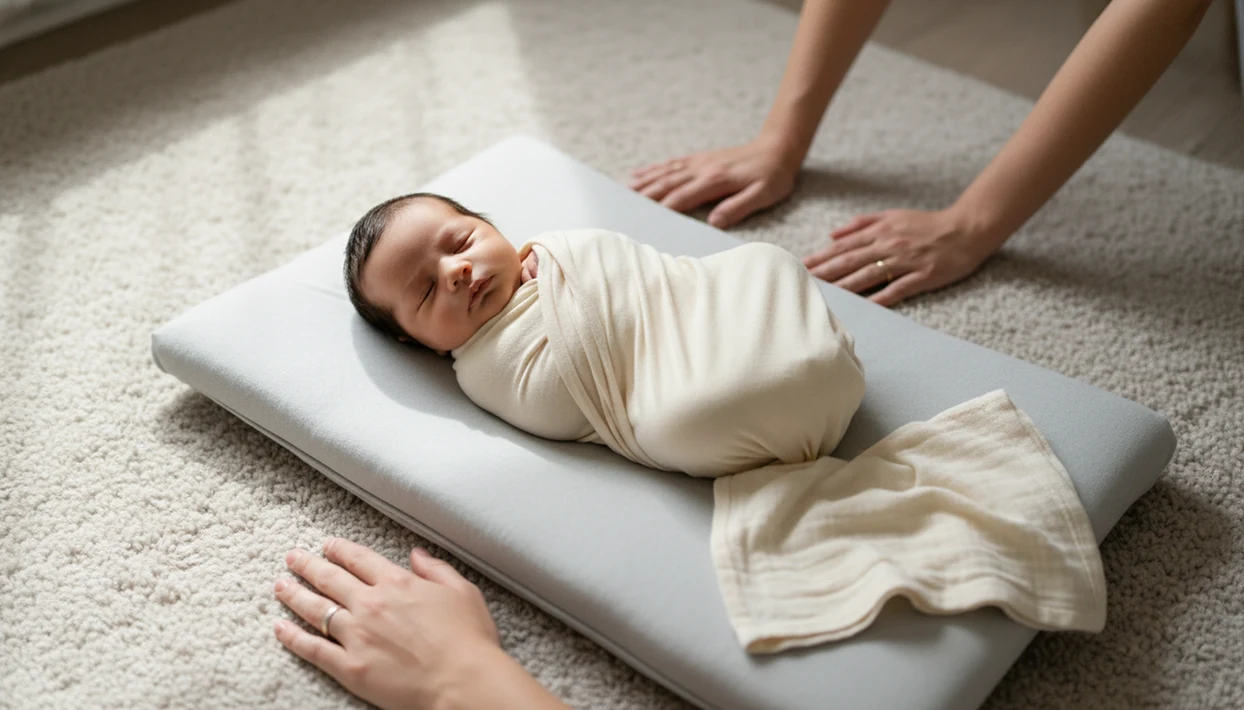
- Wrapped-on-back pose: A snug swaddle keeps arms calm, but the chest, hips, and face stay unrestricted.
- Parent-held pose: A parent supports the head, neck, and body, often creating a warmer contest-ready image than a prop setup.
- Sibling-adjacent pose: Older sibling lies beside, not holding or leaning on, the newborn while an adult stays close.
- Macro detail shots: Feet, fingers, lashes, lips, and hair swirls add variety without repositioning the baby.
Skip froggy, hanging wrap, chin-on-hands, unsupported bucket, and any pose that relies on balance. Those belong in advanced workflows, not beginner home photos.
Five Baby Posing Safety Facts Beginners Must Know
Baby posing safety starts with the surface, airway, and supervision, not the camera. These five facts turn safe-sleep principles into practical photo rules without replacing medical advice.
- Use a flat, low, stable surface. Beginner newborn photography poses should happen on a firm bed, floor mattress, or low padded setup, never on a high or unstable prop.
- Back-lying is the safety baseline. The American Academy of Pediatrics recommends back sleep for infants, and prone sleep has been associated with a 2 to 13 times higher SIDS risk than supine sleep (AAP: https://publications.aap.org/pediatrics/article/150/1/e2022057990/188304/Sleep-Related-Infant-Deaths-Updated-2022-Recommendations).
- SUID context matters. Per the CDC, about 3,400 sudden unexpected infant deaths occur in the United States each year, including SIDS and accidental suffocation (CDC: https://www.cdc.gov/sudden-infant-death/data-research/data/index.html).
- Soft objects are not styling shortcuts. AAP guidance emphasizes firm, flat, non-inclined sleep surfaces without loose bedding or soft objects.
- Stop signs are non-negotiable. End the setup if the baby has hard crying, pale or dusky color, labored breathing, limpness, overheating, or clear resistance.
Clinicians typically recommend keeping infant airways clear and sleep surfaces firm; photo setups should respect that same logic.
How Beginner Newborn Photography Poses Work
Beginner newborn photography poses work by preserving a neutral airway, supported head and neck, relaxed limbs, and a visible face while finding a flattering camera angle. The goal is not to “make” a baby hold a pose; it is to photograph a natural resting position safely.
A pose can look simple and still become unsafe. The chin can drop toward the chest. A soft blanket can bunch near the mouth. A baby who seemed settled can roll or startle. That is why a caregiver within arm’s reach matters more than the prop list.
Warmth, a recent feed when appropriate, white noise, and dim natural light can reduce startle. We like the soft gray light from a bedroom window around 10 a.m., with the phone held just above mattress height.
Quiet helps.
Photo posing is temporary, but it still uses the same airway and suffocation logic as safe-sleep guidance. The most common medically supported way to reduce airway-related risk during simple photo posing is firm surface support combined with continuous adult observation.
Best Safe Newborn Poses for Contest Photos
Strong safe newborn poses for contest photos show expression, scale, connection, and detail without asking the baby to balance or strain. Start with these five before looking at advanced inspiration.
Back-Lying Newborn Pose
Place the baby on the back with hands visible and the head gently turned only if it falls that way naturally. Photograph from above or at 45 degrees. A plain white crib sheet often beats a busy blanket.
Side-Lying Newborn Pose
Set the baby on the side with support behind the body and no face compression. Keep loose fabric away from the nose and mouth. A spotter stays beside the baby, not across the room.
Wrapped Newborn Pose
Use a snug but not tight swaddle, then place the baby on the back with the face fully visible. The wrap should not compress the hips or chest.
Parent-Held Newborn Pose
Support the baby against a parent’s chest, with hands visibly holding the head and body. These photos often carry more emotion than a complex prop scene.
Macro Newborn Detail Pose
Photograph hands, feet, lashes, lips, a hair swirl, hospital bracelet, or tiny fingers. One single flower beside tiny feet can feel contest-ready without moving the baby much.
Beginner Newborn Photography Poses Compared With Advanced Poses
Beginner poses keep the baby supported in one frame, while advanced poses often require training, hidden hands, and merged images. Many viral newborn images are composites, not single-shot positions.
| Pose | Beginner-safe status | Why | Contest use |
|---|---|---|---|
| Back-lying | Beginner-friendly when supervised | Flat, visible airway, low strain | Strong for expression and clean styling |
| Simple side-lying | Beginner-friendly when supervised | Natural rest position with support | Good for sleepy, calm images |
| Full swaddle on back | Beginner-friendly when supervised | Reduces startle without balancing | Works well with seasonal colors |
| Parent-held | Beginner-friendly when supported | Adult hands stabilize head and body | Strong emotional entry |
| Macro details | Beginner-friendly | Minimal repositioning | Great for variety and storytelling |
| Froggy | Advanced, not for beginners | Usually needs compositing and support | Avoid at home |
| Hanging wrap | Advanced, not for beginners | Suspension risk | Avoid |
| Chin-on-hands | Advanced, not for beginners | Neck and airway concerns | Avoid |
| Unsupported bucket | Advanced, not for beginners | Tipping and slumping risk | Avoid |
| Hammock or stacked hands | Advanced | Balance and airway concerns | Avoid |
For a clearer look at hidden support methods, parents can read composite newborn posing explained before copying social media poses.
Safe Newborn Poses at Home With Simple Contest Styling
Safe newborn poses at home work best on a firm bed, floor mattress, or low padded beanbag only if the setup is stable, clean, and continuously supervised. Avoid soft pillows, deep baskets, loose blankets near the face, strings, lights, unstable props, and heavy accessories.
Use side window light, neutral blankets, a simple swaddle, and one meaningful prop kept away from the airway. We often notice the real difference in the test shot: a diaper sleeve in the corner, a pacifier clip near the shoulder, or a burp cloth breaking the clean background. Remove those before the final frame.
Contest composition can stay simple. Try negative space, a close crop, parent hands for scale, seasonal color, or a calm facial expression. Good newborn and baby photo contest ideas, photography tips, milestone shoots, and ai newborn photo inspiration deliver safer creative direction, not permission to copy risky poses.
Tools like Newborn Photo App help parents plan, edit, and share contest-ready newborn photos, but the pose still has to be safe before the photo is submitted. For broader setup planning, how to take newborn photos at home pairs well with this guide.
Common Myths About Safe Newborn Poses
A pose seen on Pinterest or Instagram is not automatically safe to copy at home. Many polished images use trained handlers, hidden supports, or merged frames that a beginner cannot see.
A risky airway angle is not fine because the photo “only takes a second.” If the chin presses down, the face is buried, or the surface is too soft, stop and reset. The awkward pause is better than forcing the frame.
A sleeping baby is not automatically comfortable or safe. Babies can sleep through overheating, slumping, or pressure against the face.
Not all tummy photos carry the same risk, but tummy posing is a poor beginner starting point. Trained photographers may use short, fully supervised tummy setups on firm padded surfaces. Beginners should start with back and side positions.
Contest-winning photos do not require dramatic props or advanced posing. Light, connection, and a clean crop usually matter more. Parents comparing themes can use newborn photo contest ideas without treating every inspiration image as a pose instruction.
Baby Posing Safety Checklist Before Every Photo
Use this baby posing safety checklist before pressing the shutter. If one item is not true, fix the setup before taking the photo.
- Surface: Firm, flat, low, stable, and free of loose objects near the baby’s face.
- Spotter: Adult within arm’s reach, never relying on a camera strap, prop, or sleeping baby to stay still.
- Airway: Chin not pressed to chest, nose and mouth visible, head and neck supported.
- Comfort: Warm room without overheating, recently fed if appropriate, clean diaper, and gentle transitions.
- Monitoring: Watch color, breathing, body tension, and crying; stop rather than force the pose.
A spotter crouched beside a beanbag is not ruining the setup. That adult is part of the safety plan. For parents who want visible support in the frame, newborn photo ideas with parents hands can turn safety into the composition.
When to Stop and Ask a Pediatrician
Stop the photo session immediately if the baby’s breathing changes, color turns blue, gray, or unusually pale, or the baby becomes limp. Ask a pediatrician first when a newborn was premature, medically fragile, recently discharged with special instructions, or has symptoms that make positioning uncertain.
Use this as a simple stop-and-escalate plan:
- Stop the pose at the first sign of labored breathing, repeated choking or gagging, unusual stillness, hard crying that does not settle, or color change.
- Move the baby into a safe, supported position with the face visible, and let the caregiver take over without trying to save the shot.
- Avoid any angle or prop that worsens reflux, congestion, feeding trouble, healing areas, tubes, monitors, casts, or other medical devices.
- Call emergency services right away if the baby is unresponsive, struggling severely to breathe, turning blue, or cannot be roused.
- Treat photographer tips, contest goals, and online inspiration as secondary to clinician guidance and caregiver judgment.
A beautiful entry is never worth overriding a parent’s concern or a medical instruction.
Limitations
No newborn pose is completely risk-free if supervision, support, or surface safety is poor. A beginner guide can reduce avoidable mistakes, but it cannot judge an individual baby in the room.
- This guide is educational and is not medical advice.
- It does not replace guidance from a pediatrician, newborn care clinician, or trained newborn photographer.
- Some babies cannot tolerate certain positions because of reflux, birth history, prematurity, medical devices, or individual discomfort.
- Tummy, bucket, froggy, hanging, and chin-on-hands poses are outside beginner scope, even when they appear common online.
- Contest goals should never override hard crying, color change, breathing concerns, overheating, limpness, resistance, or parental unease.
- Safe beginner poses can look repetitive, so creativity should come from light, crop, styling, family connection, and editing rather than risky positioning.
- Twins and multiples need extra caution because one baby’s movement can affect the other; twins newborn photo ideas should still keep each baby supported.
If your gut says the setup feels off, stop.
FAQ
What newborn poses are safest for beginners?
Back-lying, simple side-lying, wrapped-on-back, parent-held, and close-up detail poses are generally safest for beginners when the baby is supervised. Each pose should keep the baby supported on a firm, flat, low surface.
Are newborn tummy poses safe for beginner photos?
Tummy poses require more caution because the airway and face position are harder to monitor. Beginners should prioritize back-lying and side-lying poses.
Is froggy pose safe for newborn photography beginners?
No, froggy pose is an advanced newborn photography pose and is usually created with compositing and constant support. Beginners should not attempt it at home.
Can beginners use props for newborn photos?
Beginners can use low, stable, nonrestrictive props that stay away from the baby’s airway. Baskets, buckets, hanging props, strings, and unstable items are unsafe for beginners.
How should a newborn be swaddled for photos?
A photo swaddle should be snug but not tight, with the face visible and the chest and hips not compressed. The baby should be placed on the back and watched continuously.
What surface is safest for newborn photos at home?
A firm, flat, low, stable surface is safest for home newborn photos. Keep soft bedding, pillows, and loose objects away from the baby’s face.
Can parents pose a newborn without a spotter?
A second adult spotter is strongly preferred, especially for side-lying, sibling-adjacent, or prop-based setups. A newborn should never be left unattended in any pose.
What newborn poses work best for baby photo contests?
Expressive, well-lit, safe photos often work better than complex poses, especially parent-held images, back-lying portraits, wrapped-on-back photos, and macro details. Newborn Photo App can help compare crops and choose a contest-ready image.
When should I stop posing a newborn for photos?
Stop immediately for hard crying, color changes, breathing changes, overheating, limpness, resistance, or parental unease. Do not continue a pose just to finish an entry for NPC or any other contest.