
Twin newborn photoshoot ideas
By the Newborn Photo App team · Updated
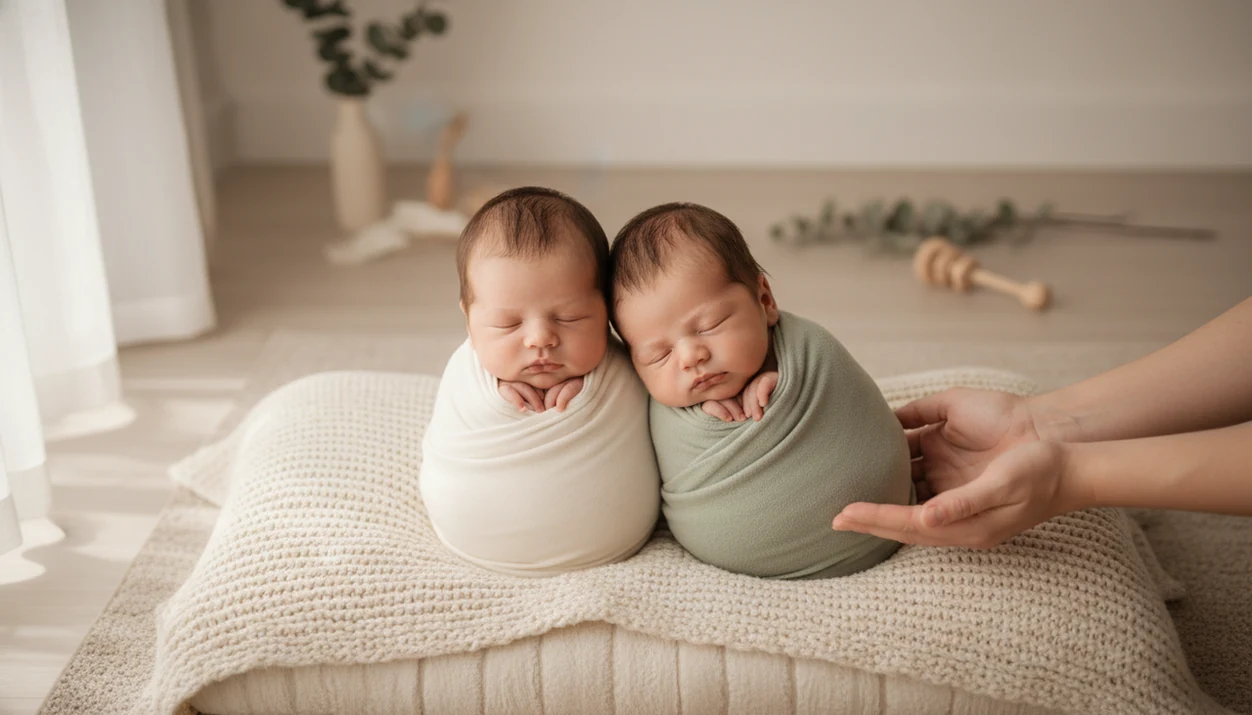
A twin newborn photoshoot works when you plan around one rule, one adult for every baby. Twins are easier to photograph side by side than most parents expect, since both can sleep on the same flat surface, but you cannot hold a camera and keep two babies safe at once. Get a second and ideally a third adult, plan the order of shots, and keep the session short.
Why safety comes first when photographing newborn twins
Everything in our guides to safe newborn poses and poses to avoid applies twice over with twins. Four rules matter most.
- One adult per baby. Each baby needs a person whose only job is that baby. The photographer is not one of them.
- Back to sleep, firm and flat. Both babies go on their backs on a firm, flat surface with no pillows or loose bedding, as the American Academy of Pediatrics advises for sleep. The AAP has no special exemption for photo props.
- Do not stack or tuck babies together on a soft surface. Twins who lie side by side should have clear space around their faces and no fabric pulled across either of them.
- One baby at a time on any pose that needs more than a flat back lie. A twin on a parent's chest means the other baby is held or lying flat with another adult.
The same warm room, short session and breaks for feeding apply. With twins, one baby often wakes and sets off the other, so be ready to stop.
How to plan the order of a newborn twin photo session
Sequencing is the real skill with twins. A good order saves time and keeps both babies calm.
- Feed both babies shortly before you start. Do it in turn, and try to line up their naps.
- Start with the sleepier baby. Take their solo shots first while the other one sleeps or is held.
- Switch and photograph the second baby alone. Solo portraits give you two clean images and a calm start.
- Do the pair shots on a flat surface once both are settled. Side by side, head to toe, or facing each other with a gap, each with a hand resting on them.
- Finish with parents. One baby in each parent's arms, or a parent's chest with one baby while the other is held by a partner.
If one twin falls apart, do not push for the pair. Soothe, feed and try again, or take the pair picture another day. Photographers often split twin sessions across two shorter visits. That is a fine choice for a home session too. For the best timing, see when to take newborn photos, since twins often arrive early and may need a later date.
Composites for newborn twin poses
Some popular twin images show two babies tucked together, heads touching, or in a single basket. Those are almost always composites, assembled from separate frames where each baby was supported and photographed on their own. The idea is simple, and the same method explained in how composite newborn posing works applies.
For twins, a composite lets you place two babies in an image they never shared, without squashing them together. You shoot twin A in the pose, then twin B in the same spot with the same lighting and framing, and merge them. A tripod or a fixed phone stand keeps the camera in place between shots. You gain a lot of safety, and you lose nothing the viewer will notice.
Matching or contrasting outfits for newborn twins
Parents of twins often ask whether to dress them the same. There is no rule, and both approaches work.
- Matching. Same wrap or outfit, same color, a symmetrical pair shot. It makes a neat, calm image and suits identical twins.
- Contrasting. Two shades of the same color, or one pattern and one solid. It helps people tell non-identical twins apart in a photo, and it helps you tell them apart in editing.
- Name tags. Small, soft, tagless wristbands or a note in your phone gallery stop you losing track of who is who. Do not leave anything on the baby after the session.
Keep to simple, soft wraps and avoid anything tight around the neck. If you want outfit help, our page on newborn photoshoot outfits has it.
Newborn photo ideas that suit two babies
- Two tiny profiles facing each other with a gap between them.
- Four feet in a row on a flat mat, shot from above.
- Two hands, one from each baby, held in a parent's palm.
- One baby asleep, one awake and looking at the camera, each with an adult's hand beside them.
- Each parent with one baby on the chest, taken from behind.
- An older sibling sitting with an adult, touching a twin's foot.
For hand-based family shots, see newborn photos with parents' hands. If you are learning from scratch, start from our newborn photography pages and add the second baby once you feel confident with one.
Twins and other multiples are more often born early, so ask your pediatrician about timing if either baby was early, spent time in the NICU or has feeding problems. Call them if either baby seems unwell after a session.
If you also have an older child, our guide to newborn sibling photos shows how to include them safely, and the newborn family photoshoot page covers group shots.
Questions about twin newborn photos
How do you photograph twin newborns safely?
Use one adult per baby, place both on their backs on a firm, flat surface with nothing soft around them, and keep a hand on each baby throughout.
Are twin newborn photos composites?
Many dramatic ones are. Photographers shoot each baby separately in the same spot and merge the frames, so neither is left unsupported.
Should twins wear matching outfits for newborn photos?
Either works. Matching wraps give a tidy look, while contrasting shades help viewers tell non-identical twins apart.
How many people do I need for a twin newborn photoshoot?
At minimum, one adult per baby plus a person to take photos. If that is not possible, keep to simple shots with a stand and timer.
What is the best order to photograph twin newborns?
Feed both, photograph each twin alone, then both together on a flat surface, and finish with parents. Solo shots first protect you if the pair shot fails.
How long should a twin newborn photo session last?
Plan about an hour with plenty of feeding and soothing breaks. Two babies tire at different times, so follow the one who needs a rest.