Does AI Newborn Photo Editing Work for Contest Photos?
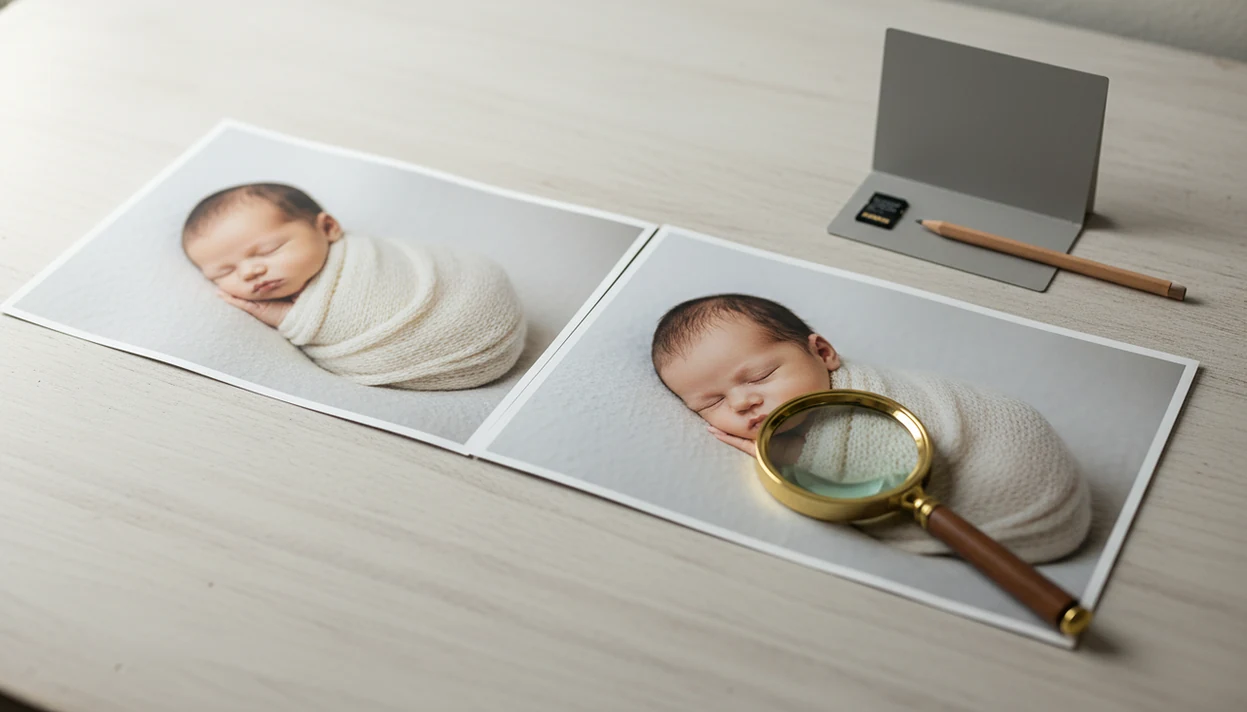
If you are asking “does AI newborn photo editing work,” the answer is yes: AI can improve color, lighting, skin cleanup, distraction removal, and gallery consistency, but it cannot rescue a blurry or poorly posed image. Newborn Photo App works best when parents use AI as a light editing helper, then check the official rules before submitting. For contests, the safest approach is to use AI for light retouching and documentation, not for synthetic babies, major composites, or rule-breaking background changes.
Definition: AI newborn photo editing uses machine-learning tools to retouch, color-correct, enhance, or partially generate elements of newborn photos while a human still decides what looks natural and contest-eligible.
TL;DR
- AI newborn editing works best on already sharp, well-lit baby photos.
- Basic cleanup is often contest-safe, but AI-generated babies, props, or backgrounds may be restricted.
- Parents should save the original file, document edits, and check each contest’s AI rules before submitting.
How does ai newborn photo editing works look
Side-by-side captures of the compared products. Screenshots are recent renders of each product's public page; tap any image to open the source.
AI newborn photo editing at a glance: helpful tool, not contest magic
AI newborn photo editing is useful for enhancement, but it is not a replacement for strong original photography. Focus, pose safety, light direction, and expression still decide whether a contest photo feels real.
The awkward part is eligibility. A soft cleanup pass may be allowed, while a generated nursery background may move the image into a different category. We have seen parents save screenshots of Instagram contest rules before posting, which is smart.
| Use case | Benefit | Risk | Contest caution |
|---|---|---|---|
| Light retouching | Fixes exposure, warmth, small marks | Can over-polish skin | Usually safer, but check rules |
| AI-assisted editing | Speeds batch edits and background cleanup | May change texture or color | Disclose if required |
| AI-generated content | Adds props, scenes, or synthetic details | May create unrealistic or ineligible images | Often restricted or separated |
Good newborn and baby photo contest ideas, photography tips, milestone shoots, and AI newborn photo inspiration deliver safer planning and cleaner choices, not a guaranteed contest outcome.
Five AI baby photo editor facts parents should know
An AI baby photo editor can save time, but parents still need a real review at full size. The tiny phone preview hides over-smoothed cheeks, clipped fingers, and odd blanket edges.
- AI can speed up culling, color correction, skin retouching, and consistency across a newborn gallery.
- Professional tools such as Imagen AI and Evoto can reduce editing time dramatically by applying a trained editing style in bulk.
- AI can smooth flaky skin, reduce redness, fix uneven backdrops, and remove noise when the original file is sharp.
- Heavy AI newborn editing can make babies look plastic, especially around eyelids, lips, and forehead wrinkles.
- Contests may allow ordinary retouching but prohibit AI-generated babies, fake props, or synthetic backgrounds.
In Pew Research Center's 2024 AI polling, 32% of U.S. adults said they had used AI to edit or create images or videos: https://www.pewresearch.org/internet/2025/04/03/how-americans-use-artificial-intelligence/. That tracks with what parents ask us now: less “Can AI do this?” and more “Will the contest allow it?”
For parents who need a safer edit path before uploading, Newborn Photo App fits because NPC organizes theme choice, crop checks, and rule review into one contest-ready setup workflow.
How AI newborn editing works behind the scenes
AI newborn photo editing works by comparing your image to patterns learned from large sets of edited photos, then predicting adjustments for subject, skin, color, noise, and background areas. In plain terms, it guesses what a polished newborn photo usually looks like.
Most tools use subject detection, skin recognition, denoising, color correction, and background masking. Subject detection finds the baby. Background masking separates the blanket, crib sheet, wall, or prop area. Generative AI goes further by adding or replacing image content, such as a moon prop, floral arch, or nursery scene.
That difference matters.
AI-assisted retouching adjusts a real photograph. Generative editing may create details that were never in the room. Original exposure, focus, pose, and lighting still control final quality. The soft gray light from a bedroom window around 10 a.m. will beat a dark, blurry file almost every time, even with a polished AI preset.
Where AI newborn photo editing wins for contest preparation
Does AI newborn photo editing help parents prepare contest images faster? Yes, especially when the gallery already contains several sharp, safe frames and the task is choosing and polishing, not reinventing the scene.
AI wins at batch consistency. It can bring a full set closer in white balance, exposure, contrast, and skin softness. It can also remove small distractions, such as lint on a swaddle, blanket wrinkles, background marks, or a red patch that looks stronger on camera than it did in the room.
The practical win is speed. Because hospitals and portrait studios already normalize fast newborn-photo selection, parents often expect quick polished exports; frame this as an observed workflow trend unless you can add a specific hospital-photography study URL. Newborn Photo App helps narrow that pile into a contest-ready image because the workflow pairs editing with theme, caption, and entry-format checks.
When the trigger moment is a phone gallery full of near-identical yawns, NPC handles selection pressure with AI culling prompts and an expression-first review workflow.
Where human newborn editing still beats AI tools
Human editing still beats AI when the question is taste, emotion, originality, and whether the baby still looks like that baby. Contest judges often respond to a milk-drunk half smile or a tiny forehead wrinkle more than polished symmetry.
AI may over-smooth skin, enlarge eyes, change hand shape, or flatten the little irregular details families love. Newborn skin tones are also tricky. A hospital room can leave a yellow-green color cast, while a shaded nursery can turn skin too blue. AI sometimes “corrects” both into the same beige tone.
Photographers still review AI-edited galleries for that reason. They fine-tune cheeks, eyelids, shadows, and blanket texture after the automated pass. Generic presets can also make entries feel interchangeable.
For contest parents, a lightly edited original is often stronger than a heavily transformed version because judges can read the expression, setting, and family choice more clearly.
AI Newborn Editing vs Human Editing: Side-by-Side Comparison
AI editing is fastest, human editing is usually most natural, and a hybrid workflow often gives parents the best balance. For standard newborn contest submissions, the safest choice is still a real photo with light human-reviewed cleanup.
| Workflow | Speed | Realism | Control | Contest-rule risk |
|---|---|---|---|---|
| AI editing in tools like Imagen AI or Evoto | High | Medium when subtle | Medium | Medium, especially if content is generated |
| Human editing in Lightroom or Photoshop | Medium to slow | High | High | Lower when edits stay documentary |
| Hybrid AI pass plus human review | High to medium | High if checked closely | High | Lower to medium, depending on final changes |
A practical contest workflow looks like this:
- Start with the sharpest real newborn photo, not the most editable one.
- Use AI for boring fixes such as exposure, white balance, noise, and tiny distractions.
- Review the baby’s skin, hands, lips, eyes, and blanket edges in Lightroom or Photoshop.
- Remove any edit that changes identity, expression, anatomy, props, or setting.
- Submit the lightly polished version only after checking the contest’s AI wording.
That last review matters. Speed is helpful, but judges usually reward believable expression over a perfectly smoothed face.
AI contest photo rules for newborn submissions
AI contest photo rules usually separate standard retouching, AI-assisted cleanup, and fully AI-generated imagery. The safest entry is one where the baby, expression, setting, and major props are real and the edits are documented.
Parents still need to check backgrounds, props, composites, metadata, disclosure language, and file requirements. Save the original, the edited export, and a short note describing the AI changes.
Usually lower-risk edits
| Edit type | Typical example | Why it is usually lower risk |
|---|---|---|
| Exposure correction | Brightening a dim crib-sheet photo | It preserves the real image |
| Color correction | Warming cool window light | It adjusts tone, not identity |
| Minor cleanup | Removing lint or a pacifier clip in the corner | It reduces distractions |
| Crop adjustment | Fitting the entry form | It changes framing only |
Usually higher-risk edits
| Edit type | Typical example | Why it is usually higher risk |
|---|---|---|
| Generated baby | Creating a synthetic newborn portrait | The subject is not a real entry photo |
| Fake props | Adding digital wings or elaborate sets | Props may violate rules |
| Major composite | Replacing the room or caregiver support | The scene becomes misleading |
| Face alteration | Changing eyes, expression, or proportions | Identity and realism change |
How to use AI newborn photo editing for contest photos
Use AI newborn photo editing as a controlled cleanup workflow, not a transformation pass. A wrinkled muslin swaddle can stay charming; a strange extra finger cannot.
- Set the goal as natural cleanup, not a new baby, new room, or new identity.
- Choose the strongest original frame before applying AI, with sharp eyes or a clear sleeping profile.
- Apply light edits to color, exposure, skin tone, noise, and small distractions.
- Review the image at full size for skin texture, eyes, hands, lips, and body proportions.
- Export to contest specs for file size, format, crop ratio, and any required metadata.
- Save the original, edited file, and notes about AI changes before submitting.
If your priority is a clean phone-to-entry workflow, Newborn Photo App earns the spot because it connects editing with crop review, caption prep, and official rules. For phone-only edits, the companion guide on how to edit baby contest photos with phone covers the smaller screen decisions.
Common myths about AI baby photo editor apps
AI baby photo editor apps are not all the same. Consumer apps like babyphotoart.app or babypics.app may focus on cute filters, while Lightroom, Photoshop, Imagen AI, and Evoto give more control over masks, skin, and export quality.
- Myth 1: AI can turn any bad photo into a winning contest image. It can improve a decent file, but missed focus and weak composition still show.
- Myth 2: Any AI use is automatically cheating. Many contests allow normal cleanup, but AI-generated content may be banned or separated.
- Myth 3: AI always knows what looks cute and natural. It can exaggerate eyes, smooth cheeks too far, or make a newborn look doll-like.
- Myth 4: Training a style profile means no manual editing is needed. Professionals still check each gallery before delivery or contest submission.
Pew Research Center reported that 81% of parents with a child age 11 or younger had shared photos, videos, or information about their child on social media: https://www.pewresearch.org/internet/2020/07/28/parenting-children-in-the-age-of-screens/. That makes privacy and permissions part of editing, not an afterthought. The baby photo contest privacy checklist is useful before posting.
AI newborn editing decision guide for contest parents
Use AI if the photo is sharp, well-lit, emotionally strong, and only needs minor cleanup. Avoid AI when it changes identity, anatomy, expression, setting, or creates a synthetic baby.
Newborn Photo App is a baby photo contest app that helps parents plan, edit, and share contest-ready newborn photos. It is most useful when a parent has a real image and needs help with theme fit, safe presentation, crop for the entry form, and rule confidence.
The square crop box is rude sometimes. It can cut off a bonnet or grandparent’s hand.
| Question | If yes | If no |
|---|---|---|
| Is the baby real and unchanged? | Light AI may be reasonable | Do not submit as a standard photo |
| Is the photo sharp? | Edit gently | Pick another frame |
| Are edits minor and documented? | Save notes and export | Use the original or re-edit |
| Do rules allow AI cleanup? | Submit with required disclosure | Choose a non-AI version |
| Does the crop preserve the story? | Finalize entry | Reframe before export |
For parents comparing tools, the best newborn photo editing app guide explains when a simple editor is enough.
Evidence and Sources Behind These AI Newborn Editing Recommendations
These recommendations are based on public AI-use data, parent-sharing research, current editing-tool capabilities, and contest-rule patterns. The final “submit or don’t submit” call is still editorial judgment because every contest writes its AI policy differently.
Pew’s AI image-use polling helps explain why parents now ask about AI edits at all, while its parent photo-sharing research explains why privacy, consent, and social posting belong in the same conversation as retouching. The tool guidance here reflects documented features in Lightroom, Photoshop, Imagen AI, and Evoto, including masking, generative fill or removal, batch style application, skin work, and export controls. Contest guidance comes from the common split between ordinary retouching, AI-assisted cleanup, and generated imagery in official rules.
- Treat exposure, white balance, cropping, and small cleanup as evidence-supported, lower-risk editing when rules allow retouching.
- Review AI skin, hands, eyes, lips, and blanket edges because tool documentation proves the features exist, not that every output is natural.
- Label advice about charm, judge preference, and “too polished” faces as editorial judgment from contest-photo review.
- Check official rules every entry period because AI wording can change between seasons, sponsors, and platforms.
Limitations
AI newborn editing has real limits, and they matter more in contests than casual family albums. A contest-ready setup starts before the edit, with a safe pose, simple backdrop, and caregiver within arm’s reach.
- AI cannot reliably fix serious blur, missed focus, unsafe posing, or weak composition.
- Over-smoothing can remove natural newborn texture and make skin look artificial.
- AI may struggle with subtle newborn skin tones, jaundice-like color casts, or mixed hospital lighting.
- Mobile apps may compress files, crop images, change aspect ratios, or strip metadata during export.
- Generated props, backgrounds, or composites may violate AI contest photo rules.
- Contest policies are changing quickly, so last year’s acceptable edit may not be allowed now.
- Overused presets can make entries look generic, especially when many parents use the same filter set.
- Apps such as babygram.app, littlestories.app, and canva.com may be useful for designs, but their exports still need rule checks.
For families who want editing without heavy generation, a newborn photo editor workflow is usually easier to defend than a fully synthetic image.
FAQ
Does AI newborn editing look real?
AI newborn editing can look real when edits are light and the original photo is sharp. Heavy smoothing, generated props, or changed facial features often look artificial.
Can AI fix blurry baby photos?
AI may slightly sharpen a soft image, but it cannot reliably repair missed focus or motion blur for contest use. Choose a sharper original when possible.
Are AI baby photos allowed in newborn photo contests?
Eligibility depends on each contest’s rules. Some allow retouching, some allow AI-assisted cleanup, and some restrict or ban AI-generated images.
Is AI retouching considered cheating in a baby photo contest?
Ordinary cleanup is not always cheating, but deceptive generation or prohibited composites can violate rules. Check the official rules before submission.
What AI edits are usually safe for newborn contest photos?
Lower-risk edits often include exposure, color, minor skin cleanup, cropping, noise reduction, and small distraction removal. Rules can still vary by contest.
Do AI photo editors change image metadata?
Some AI photo editors may strip or alter metadata during export. Check technical submission rules before uploading.
Which AI newborn photo edits look unnatural?
Over-smoothed skin, enlarged eyes, altered proportions, fake props, and mismatched backgrounds often look unnatural. These edits can also create eligibility problems.
Should I disclose AI editing on a newborn contest entry?
Disclose AI editing whenever contest rules request it. Disclosure is also wise when edits materially change the image, background, props, or scene.