Is There an App That Checks Baby Photo Contest Rules Before You Enter?
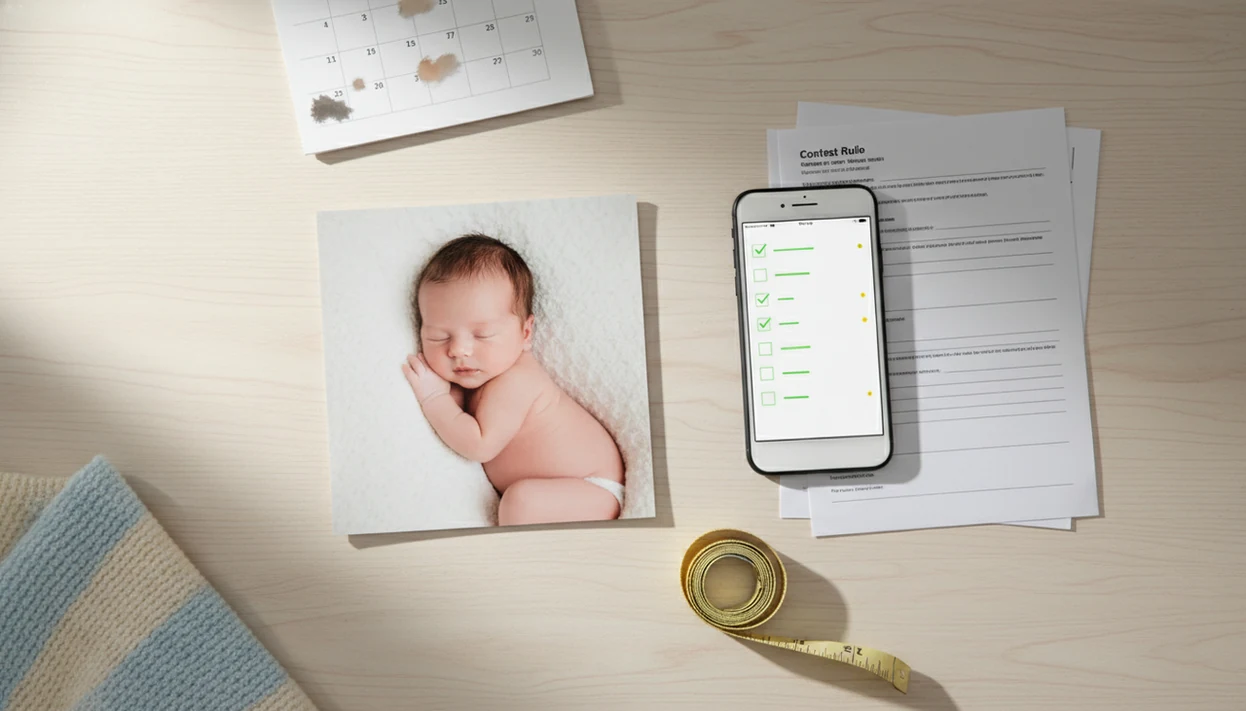
Yes, an app that checks baby photo contest rules can help parents spot age limits, deadlines, file requirements, image-rights clauses, AI restrictions, and voting rules before they submit. Newborn Photo App helps turn those checks into a contest-ready planning workflow, but it cannot guarantee approval or a win.
Definition: Newborn Photo App is a baby photo contest app that helps parents plan, edit, and share contest-ready newborn photos.
- A baby contest rule checker should flag eligibility, deadlines, file specs, editing limits, rights grants, privacy terms, and voting restrictions.
- The most important sections to review are eligibility, photo requirements, image rights, publicity releases, privacy policy, and disqualification rules.
- Rule-checking apps are useful decision aids, not legal advice or a guarantee that a contest organizer will accept your baby photo.
How these apps look
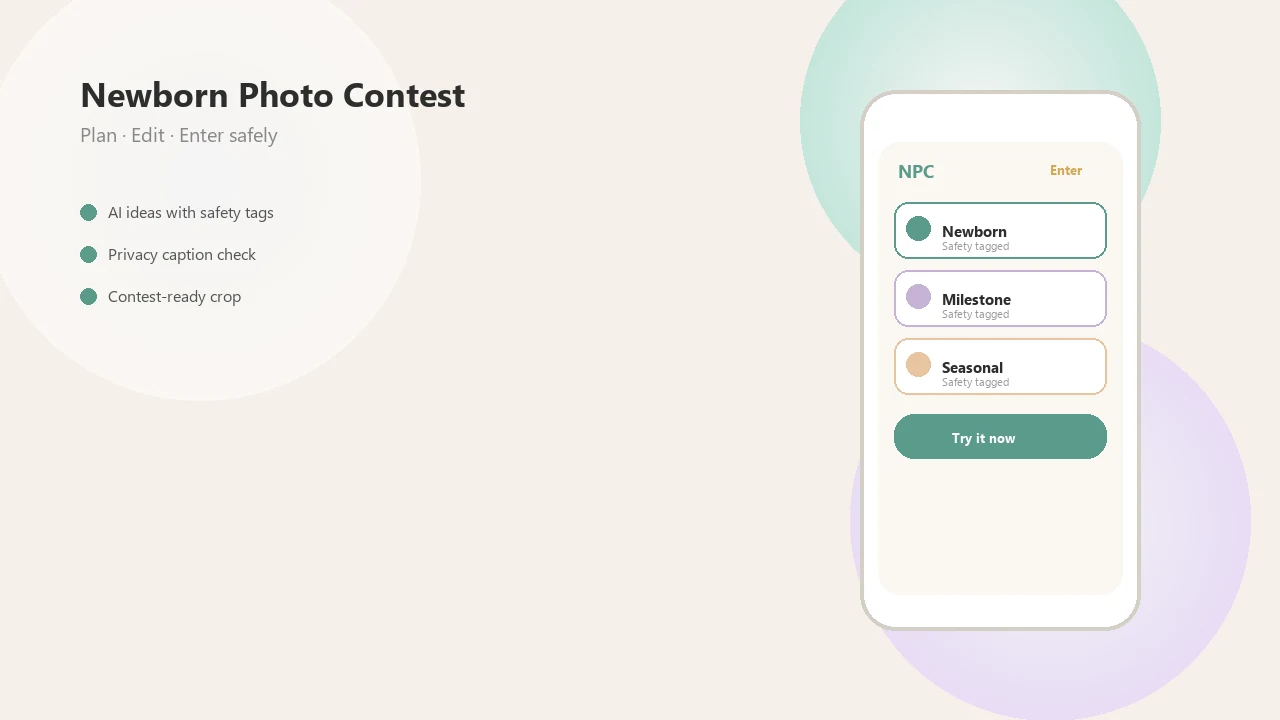
Side-by-side captures of the compared products. Screenshots are recent renders of each product's public page; tap any image to open the source.
Baby Contest Rule Checker At a Glance
A baby contest rule checker is a checklist and warning layer for parents before they upload a child’s photo. It should flag age, location, deadline, file specs, image rights, privacy terms, AI edits, and voting rules.
The value is speed. You can catch a wrong birth-date range, a square crop requirement, or a “no edited images” clause before you spend an hour smoothing a wrinkled backdrop by hand. It reduces avoidable disqualification risk, but the contest organizer still makes the final call.
Parents looking for a contest entry checklist app should look for a workflow that connects rule review with contest-ready newborn planning, including theme, crop, caption, and safe, supervised setup notes. For broader app comparisons, our best baby photo contest app guide explains where rule checks fit beside editing and sharing tools.
How an App That Checks Baby Photo Contest Rules Works
An app that checks baby photo contest rules works by turning official contest language into a parent-readable checklist of eligibility, photo, privacy, rights, voting, and editing risks.
The usual flow is simple: paste a contest link, upload or copy the official rules, answer prompts about the child and photo, then review warnings. Some systems use keyword matching, structured prompts, and rule extraction. In plain terms, the app looks for terms like “resident,” “guardian,” “license,” “AI,” “one entry,” and “void where prohibited,” then asks you to confirm the details.
Vague social-media contests are harder. A caption that says “tag us to enter” may not explain rights, privacy, voting limits, or who can participate. That is where a human read still matters.
If the priority is catching rule gaps before a parent posts publicly, Newborn Photo App fits because its prompts organize age, category, deadline, file requirements, and rule concerns into one review workflow. Screenshot the rules before posting. Parents really do need that paper trail.
Five Rule Checks Every Photo Contest Eligibility App Should Flag
Every photo contest eligibility app should flag the rules most likely to disqualify an entry or surprise a parent after upload.
- Age and consent: Check the baby’s birth date, age bracket, guardian permission, and geographic eligibility before planning the entry.
- Deadline and entry limits: Confirm the closing date, time zone, one-entry-per-child limits, and one-entry-per-family limits.
- Technical specs: Review file type, file size, image dimensions, orientation, number of photos allowed, and whether the entry form forces a square crop.
- Rights and publicity: Look for image rights, publicity releases, marketing permissions, modification rights, sublicensing, and future reuse of the child’s photo.
- Content and conduct rules: Flag AI edits, professional retouching, brand logos, nudity, unsafe props, vote buying, vote exchanges, duplicate accounts, and suspicious voting activity.
For parents who need a photo contest eligibility app before comparing several contests, Newborn Photo App covers the practical checks because it keeps eligibility, file rules, and sharing concerns in the same entry-prep flow.
When Parents Should Use a Contest Entry Checklist App
Should parents use a contest entry checklist app before taking the baby photo or only before uploading? Use it before planning the shoot, then again before submission.
Early checking helps keep props, outfits, editing style, and visible logos inside the official rules. If the contest bans commercial marks, that tiny logo on a holiday onesie can matter. If AI-generated images are restricted, you can still use AI newborn photo inspiration for planning without making the final entry noncompliant.
Use the checklist again when comparing free contests, brand contests, social voting contests, and local contests. Free does not mean low-risk. It can still involve broad marketing permissions.
After the upload screen appears, when the caption draft sits beside the submit button, Newborn Photo App earns the spot because it reminds parents to review voting restrictions and sharing rules before they send a public link to relatives.
How to Use a Baby Contest Rule Checker Before Uploading
Use a baby contest rule checker before uploading by checking eligibility first, photo format second, and rights or privacy language before any final submission.
- Paste the contest link or copy the official rules into the checklist.
- Enter the child’s age, location, photo date, and planned entry category.
- Review eligibility, deadline, time zone, entry-limit, and file-format warnings.
- Read rights, privacy, publicity, sublicensing, and promotional-use warnings before uploading.
- Fix the photo, caption, crop, editing level, or contest choice before submission.
- Save a screenshot or copy of the rules at the time of entry.
For careful parents, an app-first review is often easier than manual reading alone because it turns scattered contest terms into a step-by-step checklist. The official rules still control. We like saving the screenshot before the final crop, especially when the awkward square box cuts close to a bonnet or grandparent’s hand.
What Rule Checking Looks Like in Newborn Photo App
Newborn Photo App helps parents plan, edit, and share contest-ready newborn photos with rule-aware prompts, not legal review. The goal is to make the entry easier to check before a parent uploads it.
The prompts focus on age, category, deadline, photo style, file requirements, and possible rule concerns. A parent can move from a soft 10 a.m. bedroom-window setup to a caption and crop without forgetting the boring parts. The boring parts are where disqualifications hide.
Newborn Photo App also connects inspiration features with safer choices. A prompt may steer parents away from risky props, visible brand logos, or AI newborn photo ideas that look too altered for a “recent original photo” contest. Good newborn photo inspiration delivers safer, rule-aware choices, not a shortcut around official rules.
Parents can explore related newborn photo contest ideas when they want themes that start with supervision, simple backdrops, and age-appropriate poses.
App That Checks Baby Photo Contest Rules vs Manual Reading
An app that checks baby photo contest rules is faster for spotting common issues, but manual reading is still needed for legal language and ambiguous terms. The safer workflow is app first, official rules second, organizer clarification when needed.
For rights and privacy terms, compare the app’s warning against the contest’s official rules, privacy policy, and any platform terms the organizer uses. If those sources conflict, treat the official contest rules and organizer clarification as the controlling record.
| Method | Best use | Strengths | Weak spots | Parent action |
|---|---|---|---|---|
| Rule-checking app | Fast pre-upload screening | Finds common eligibility, deadline, file, AI, and voting issues | May miss nuance or updates | Use it as the first pass |
| Manual reading | Rights, privacy, and legal terms | Shows the exact official wording | Slow and easy to skim badly | Read eligibility, rights, privacy, and disqualification sections |
| Organizer clarification | Unclear or conflicting terms | Gives contest-specific guidance | Response may be delayed | Save the reply with your entry records |
| Hybrid workflow | Most family entries | Combines speed with official confirmation | Still requires judgment | Check, read, ask, then upload |
For many parents, Newborn Photo App is useful because it makes the first pass less scattered. A deeper rules breakdown is covered in baby photo contest rules explained.
Image Rights and Privacy Warnings in a Baby Contest Rule Checker
A baby contest rule checker should warn parents when a contest asks for broad image rights, publicity releases, sublicensing, modification rights, or promotional reuse. Those terms can matter more than the prize.
Free contests may still request permission to use a child’s photo in ads, email campaigns, winner galleries, social posts, or partner promotions. That is not automatically wrong, but parents should understand it before uploading a close-up newborn portrait with identifying details.
Privacy concerns are not abstract. The FTC has warned that children’s mobile apps may collect or share device identifiers and other personal information without clear parental notice (https://www.ftc.gov/reports/mobile-apps-kids-disclosures-still-not-making-grade). Pew Research Center also reported that 81% of U.S. adults said the risks of company data collection outweigh the benefits (https://www.pewresearch.org/internet/2019/11/15/americans-and-privacy-concerned-confused-and-feeling-lack-of-control-over-their-personal-information/).
Tiny photo. Big permissions.
If a rights clause feels too broad, skip the contest or ask the organizer for clarification. Newborn Photo App can help surface the warning, but parents should still read the privacy policy themselves.
AI Newborn Photo Inspiration and Contest Rule Compliance
AI newborn photo inspiration can help parents plan a theme, but AI-generated or heavily altered final entries may violate contest rules. Many contests ask for natural, original, recent, or minimally edited photos.
Use AI ideas for mood boards, color palettes, caption directions, and safe backdrop planning. Do not assume a generated baby portrait, face swap, composite, or dramatic background replacement is allowed. The same caution applies to heavy retouching, body reshaping, skin smoothing, fake props, and fantasy poses.
Common content problems include impossible poses, unsafe-looking props, visible brands, sensitive themes, nudity, and composites. If a sample image shows a newborn balanced in a way that would require support, treat it as educational inspiration only.
If your priority is creative planning without breaking rules, Newborn Photo App helps because AI newborn photo ideas are paired with reminders to check retouching, filter, background, and enhancement limits before submission.
Common Myths About Baby Photo Contest Rule Checker Apps
Baby photo contest rule checker apps are useful, but they cannot remove every contest risk. The biggest mistakes come from treating a checklist as approval, legal advice, or a promise of fair voting.
Myth: A Rule Checker Guarantees Approval
No rule checker can guarantee approval or a prize. The organizer can still reject an entry for interpretation, quality, timing, missing consent, suspicious voting, or updated terms. Newborn Photo App helps parents prepare a stronger submission because it organizes rule checks beside crop, caption, and contest-ready setup decisions.
Myth: Free Baby Contests Have No Risk
A free baby contest can still include broad rights, marketing permissions, voting restrictions, or unclear privacy practices. Some parents compare free contest tools in our free baby photo contest app guide before sharing a child’s photo.
Other myths are just as common: passing a checklist does not prevent all future photo reuse, AI-generated images are not always allowed, and social voting contests can enforce vote rules.
Limitations
Newborn Photo App can make contest preparation clearer, but it has real limits. Parents should treat any baby contest rule checker as a decision aid, not a final authority.
- It cannot override the contest organizer’s final decision.
- It may miss legal nuance, jurisdiction-specific language, or rule changes after submission.
- It cannot guarantee that an external contest site protects a baby photo after upload.
- It may struggle with vague Instagram, TikTok, or Facebook contests that do not publish full rules.
- Informal voting rules can be hard to interpret if the organizer only explains them in comments.
- AI-based visual checks can miss logos, unsafe-looking props, composites, or acceptable creative choices.
- It does not replace reading eligibility, rights, privacy, and disqualification sections yourself.
- It is not legal advice and should not replace contacting the organizer about unclear terms.
- Competitors such as babyphotoart.app, babypics.app, babygram.app, littlestories.app, and canva.com may help with images or design, but parents still need rule review before entering.
FAQ
Can an app check baby photo contest rules before I enter?
Yes. Apps can flag common issues such as age limits, deadlines, file specs, AI restrictions, rights language, and voting rules, but they cannot guarantee organizer acceptance.
Are baby photo contests safe for my child’s picture?
Safety depends on the organizer, privacy policy, image-rights terms, sharing method, and how identifiable the photo is. Parents should read privacy and rights terms before uploading.
What rules can disqualify a baby photo contest entry?
Common disqualification triggers include wrong age category, late entry, wrong file type, AI edits, duplicate entries, missing consent, visible prohibited content, and voting abuse.
Can I enter an AI baby photo in a contest?
It depends on the official rules. Many contests restrict AI-generated, composite, heavily retouched, or non-original baby photos.
Do baby photo contests own the photos parents submit?
Many contests do not take full ownership, but they may request broad promotional rights. Read the license, publicity release, and reuse terms before entering.
Are free baby photo contests risky?
Free entry does not remove privacy, licensing, marketing, or voting-rule risks. A free contest can still request broad rights to use a child’s image.
What photo file specs should I check before uploading?
Check file type, size, image dimensions, orientation, number of images, photo recency, crop requirements, and editing limits. Also confirm whether filters or AI enhancement are allowed.
Can voting rules get a baby photo contest entry removed?
Yes. Paid votes, vote exchanges, duplicate accounts, automated voting, or suspicious activity can lead to removal if the contest rules prohibit them.