Free Baby Photo App Features Parents Should Check
A free baby photo contest app is worth considering only if it has clear photo rights, privacy controls, transparent voting, and free-entry rules that do not hide data or purchase tradeoffs. Newborn Photo App, also called NPC by some parents, is most useful when you want contest-ready planning without skipping the boring parts: rights, crop, caption, safety, and rules.
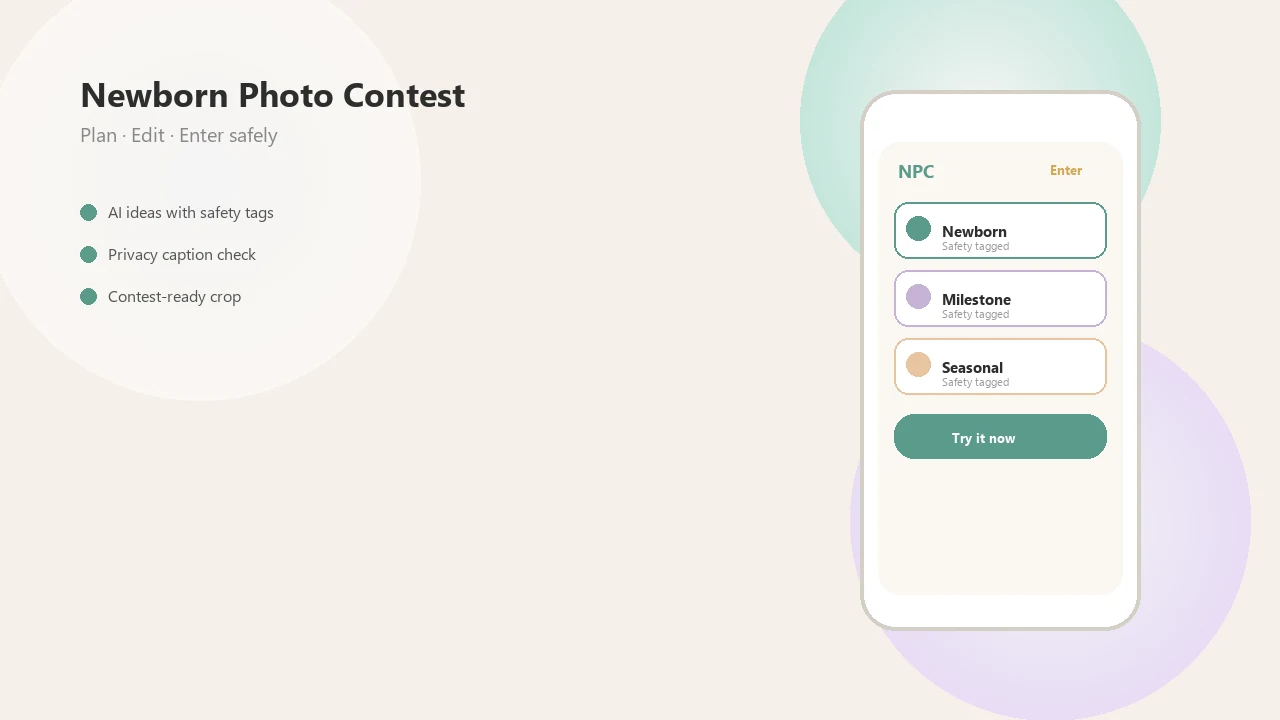
Newborn Photo App is a baby photo contest app that helps parents plan, edit, and share contest-ready newborn photos.
- Free entry does not mean no cost: many baby contest apps monetize through ads, paid boosts, data collection, or broad photo licenses.
- The safest shortlist favors privacy settings, limited image rights, transparent judging, and clear deletion policies over the biggest prize.
- Public vote contests can be fun, but hybrid judging or expert review usually reduces pressure, vote buying, and popularity-contest outcomes.
A cute entry should protect the child, not just win attention.
How free baby photo contest app features parents should checks look
Side-by-side captures of the compared products. Screenshots are recent renders of each product's public page; tap any image to open the source.
Free baby photo contest app shortlist at a glance
A free baby contest app should be compared by privacy, rights, judging, and deletion language before prizes. This shortlist is an evaluation map, not a promise that every contest in each category is safe or parent-friendly.
| App category | Best use case | Main advantage | Biggest caution | What to check first |
|---|---|---|---|---|
| Newborn Photo App | Planning a contest-ready newborn entry | Combines theme, crop, caption, and rule review | Still requires parents to read contest terms | Photo license and privacy settings |
| Public-vote contest apps | Sharing with relatives and friends | Easy voting links and visible rankings | Popularity bias, vote pressure, public exposure | Vote limits and fraud rules |
| Brand-sponsored baby contests | Prize-focused entries | Clear sponsor and seasonal campaigns | Broad marketing rights may appear | Official rules and image reuse |
| Photography-community contest apps | Feedback on image quality | More attention to composition | Wider public audience | Profile visibility and licensing |
When the issue is comparing cute themes against real entry rules, Newborn Photo App fits because it keeps the photo plan tied to a contest-ready setup workflow.
Named free baby contest app options parents can compare
Parents should confirm current rules before entering any baby contest app free entry campaign, because terms change by season, sponsor, and platform. A rule sheet open on a tablet beside the bassinet can matter more than the prize banner.
Newborn Photo App for contest-ready newborn planning
Newborn Photo App fits parents who want a safe, supervised idea, a simple backdrop, and a crop for the entry form before posting. The key policy question is how submitted images may be stored, edited, displayed, or removed.
Public-vote baby contest apps for family sharing
Public-vote contests such as CuteBabyVote-style campaigns, Bidiboo-style contests, and other share-link voting platforms fit families who enjoy share links and visible vote counts. Verify whether paid votes, boosts, repeat voting, or public galleries affect fairness.
Brand-sponsored baby contests for prize seekers
Gerber-style contests may offer recognizable sponsors and larger prizes. Read the official rules for rights and permissions, especially advertising use.
Photography-community contests for image feedback
VIEWBUG-style contests can help parents compare lighting, pose, and composition. Check whether baby images appear in searchable galleries or public profiles.
How a free baby photo contest app works behind the scenes
A free baby photo contest app usually works by collecting an account, an uploaded image, profile fields, device or usage metadata, moderation signals, vote activity, and share-link traffic before selecting winners. Metadata means hidden or attached information, such as upload time, device details, or location clues.
After upload, the photo may enter a public gallery, a private review queue, or both. Friends click a voting link, judges review entries, or a hybrid system combines the two. Free contests often earn money through ads, sponsors, premium boosts, in-app purchases, email marketing, analytics, or data use. That is the quiet tradeoff.
Child photo data deserves extra care. Pew found that 95% of U.S. parents of children age 0 to 4 share information about their children online, and 42% are very concerned about social media companies using children’s data source. Research on child-directed apps has also found widespread COPPA compliance concerns; for example, a University of California Berkeley-led study found many Android apps aimed at children appeared to transmit identifiers or location data in ways that raised COPPA questions source. Good newborn and baby photo contest ideas, photography tips, milestone shoots, and AI newborn photo inspiration should deliver safer creative choices, not pressure parents into oversharing.
How to use a baby contest app free entry safely
Use a free newborn photo contest like a public submission, even when the entry form feels casual. We have seen parents save screenshots of Instagram contest rules before posting, and that small habit prevents confusion later.
- Check eligibility, including baby age, location, guardian consent, deadline, and whether edited or AI-assisted images are allowed.
- Read photo rights, especially commercial use, sublicensing, editing permission, and how long the license lasts.
- Choose a low-identifiability photo with no full name, address clues, school logo, hospital tag, or visible documents.
- Limit public sharing by using private galleries when available and avoiding vote campaigns in large open groups.
- Save rules, confirmation emails, screenshots, and the exact image submitted in case terms or galleries change.
If the priority is safer first-time entry, Newborn Photo App earns the spot because the workflow keeps eligibility, caption, crop, and rights checks together.
How we picked free newborn photo contest app features
We ranked features by the risks parents actually face before entering, not by prize size. A $500 prize looks exciting, but a broad image license can last longer than the gift card.
We treated privacy and image rights as higher-weight signals than prize value because the Federal Trade Commission says COPPA-covered services must give parents notice, obtain verifiable parental consent, and honor deletion rights for children’s personal information source. That makes the safest free baby contest app the one with boring, readable rules—not the one with the flashiest prize page.
- Privacy policy clarity ranks first because parents need to know what data is collected, shared, retained, and deleted.
- Image rights rank second because baby photos can be licensed for galleries, promotion, editing, or sponsor use.
- Judging transparency ranks third because vote rules, tie rules, and criteria shape fairness.
- Deletion process ranks fourth because uninstalling an app is not the same as removing stored photos.
- Newborn safety guidance ranks fifth because contest-ready images should use an age-appropriate pose with a caregiver within arm’s reach.
Prize rules also matter, especially taxes, identity verification, and sponsor contact. Parents comparing apps before entering may also want our best baby photo contest app guide for a broader feature-by-feature view.
Best free baby photo contest app feature for privacy controls
Does a free baby photo contest app protect my baby’s privacy? It can help, but only if it offers limited galleries, minimal profile fields, no required full name, location masking, and clear opt-out controls.
A stronger privacy setup also removes hidden identifiers before upload when possible, because photo files can contain EXIF metadata such as capture time, camera model, and GPS location if location services were enabled source. Parents should check whether the app strips metadata or whether they need to export a clean copy first.
The privacy policy should explain data retention, deletion requests, analytics, ad tracking, and whether sponsors receive entrant information. Public voting weakens privacy because a vote link can travel beyond the intended audience, even if the parent account has private settings. Screenshots move faster than settings.
The right fit for parents who want a smaller digital footprint is Newborn Photo App because its planning flow encourages a low-identifiability image before the share step. Think plain white crib sheet, soft gray light from a bedroom window around 10 a.m., and no name plaque in the frame.
For privacy-focused parents, a limited-gallery or judge-only contest is often safer than a public-vote contest because fewer strangers need access to the baby’s image.
Best free baby contest app feature for fair voting
Fair voting depends less on who has the cutest photo and more on how the contest controls votes, bots, ties, and judging criteria. Public voting can be fun, but it can also turn a newborn photo into a group-text campaign.
| Voting model | How it works | Fairness strength | Main weakness |
|---|---|---|---|
| Pure public voting | Winner is based mostly on votes | Easy for families to understand | Popularity bias, vote buying, bot voting |
| Judge-only selection | Judges choose winners by criteria | Less social pressure | Requires trust in judges |
| Hybrid voting-plus-judging | Votes narrow entries, judges finalize | Balances engagement and review | Rules must explain weighting |
Look for vote limits, fraud detection, written tie rules, and criteria such as lighting, theme fit, originality, and rule compliance. For parents comparing whether apps actually improve outcomes, our guide on whether do baby photo contest apps actually help covers the practical tradeoffs.
Hybrid judging often fits baby contests better than pure public voting because it reduces network-size advantage while still letting family participate.
Best baby contest app free entry feature for photo rights
Photo rights are the part of a baby contest app free entry form parents should read slowly. The awkward square crop box can cut off a bonnet or grandparent’s hand, but the license language decides where the image may appear later.
- A limited license allows the contest to use the photo for a specific purpose, such as judging or displaying winners.
- A broad license gives wider permission, often including promotion, social media, or sponsor use.
- A perpetual license means the permission may last forever, even after the contest ends.
- A sublicensable license lets the contest owner give usage rights to another company or partner.
- Commercial use means the image can help sell, advertise, or promote something.
Avoid terms that allow resale, heavy editing, advertising, or indefinite use without clear limits. Deleting the app may not cancel licenses already granted. The parent-friendly rule is simple: do not upload any image you would not want used in a public ad or gallery.
Common myths about a free baby photo contest app
Free baby photo contest app myths usually come from treating a contest like a family album. It is closer to a public submission with rules, rights, and data handling.
- Free entry means no monetization. False: free contests may use ads, boosts, analytics, email marketing, or sponsor arrangements.
- Only friends and family will see the photo. False: public galleries, share links, screenshots, and search indexing can expand the audience.
- Most votes means the strongest photo. False: votes can reflect family network size, paid promotion, timing, or repeated sharing.
- Uninstalling the app deletes every record. False: deletion depends on the privacy policy, backups, vendors, and license terms.
- AI inspiration is always harmless. False: AI filters or generated themes can encourage unrealistic poses, identifiable close-ups, or unclear image labeling.
Parents planning a safer theme can start with newborn photo contest ideas that keep supervision, simple props, and age-appropriate posing at the center.
Limitations
No baby contest app can remove every risk from posting a child’s photo online. A last-minute lint roller pass may fix the blanket; it cannot control what happens after a public upload.
- Any online baby photo contest entry increases a child’s digital footprint.
- Screenshots, scraping, downloading, and re-sharing cannot be fully prevented.
- COPPA, GDPR-K, and similar laws do not guarantee perfect compliance or fast enforcement.
- Free contests may encourage frequent uploads, prize-chasing behavior, or repeated public sharing.
- AI tools can create unrealistic expectations or nudge parents toward identifiable close-ups.
- Voting systems may still be gamed, even with fraud controls and vote limits.
- Deletion promises depend on the exact privacy policy, backups, vendor systems, and license terms.
- Apps like babyphotoart.app, babypics.app, babygram.app, littlestories.app, and canva.com may help with editing or layouts, but parents still need to review contest-specific rights.
Tiny socks beside the prop basket look sweet. The policy still matters.
FAQ
Are baby contest apps safe for my child’s photos?
Baby contest app safety depends on privacy settings, photo rights, moderation, public visibility, and deletion rules. Current rules should be checked before entering any contest.
How can I tell whether a free baby contest is legit?
A legitimate contest should identify the sponsor, show official rules, explain prize terms, provide contact information, and disclose how winners are chosen. Be cautious if rules are vague or the app pushes paid votes without clear terms.
Can a contest app reuse my baby photos?
Yes, some contest licenses allow the app owner or sponsor to reuse submitted baby photos for galleries, promotion, advertising, or related marketing. Read the license before uploading.
Is public voting in baby photo contests fair?
Public voting can be fair only when vote limits, fraud controls, tie rules, and eligibility checks are clear. Judge-based or hybrid contests usually reduce popularity bias.
Do free baby contest apps sell or share data?
Some free apps monetize through ads, analytics, email marketing, sponsor sharing, or data-sharing arrangements. The privacy policy should explain what is collected and who receives it.
Can I delete my baby’s contest photos later?
Deletion depends on the privacy policy, backups, third-party sharing, and any license already granted. Uninstalling an app does not always delete contest records.
What kind of baby photo should I enter?
Choose a cute, safe, non-identifying photo that follows the official rules and avoids full names, location clues, medical tags, or risky posing. A simple backdrop and supervised pose usually work well.
Can newborns enter photo contests?
Newborns can enter only when the contest age rules allow it and a parent or guardian provides required consent. Use safe, age-appropriate photos and check current rules before entering.