AI Baby Photos Contest Rules Parents Should Read Before Entering
Quick answer: AI baby photos contest rules usually decide whether an entry must be a real camera photo, whether AI editing is allowed, and what parents must disclose before submitting. In most baby photo contests, fully synthetic baby images are risky unless the official rules clearly allow AI-generated entries.
Definition: AI baby photos contest rules are the eligibility, originality, editing, likeness, and disclosure clauses that govern AI-generated or AI-edited baby pictures in a photo contest.
TL;DR
- Assume a baby photo contest wants a real child photographed by a camera unless the rules explicitly allow synthetic or AI-generated images.
- Light AI-assisted edits such as sharpening, denoising, or exposure cleanup may be allowed, but adding a baby, face, outfit, background, or major scene element can violate originality rules.
- Parents should keep the original camera file, disclose AI use when asked, and confirm consent, age, safety, and likeness rights before entering.
AI Baby Photos Contest Rules at a Glance
Most contests separate three things: real-camera baby photos, AI-assisted edits, and fully synthetic images. Undisclosed AI can cause disqualification when the rules require original work, real photography, or truthful editing.
The safest first read is the eligibility section, not the prize page. Standard baby contest rules still apply, including child age, guardian consent, safe posing, nudity limits, residency, and prize eligibility. For U.S. prize promotions, parents should also watch for fee requests, vague sponsor names, and prize-claim language that resembles sweepstakes scams; the FTC warns consumers about fake prize and sweepstakes tactics at https://consumer.ftc.gov/articles/fake-prize-sweepstakes-lottery-scams. The square crop box on an entry form can be annoying, but the fine print matters more than whether it cuts off a bonnet.
Newborn Photo App is a baby photo contest app that helps parents plan, edit, and share contest-ready newborn photos. Tools can help with format and planning, but they do not override official rules.
Small edits are not the same as synthetic entries.
AI Baby Photo Contest Rule Clauses Parents Should Scan
AI-generated images are pictures created partly or fully by software instead of a camera. AI-assisted editing means software improved a real photo, such as denoising, sharpening, or exposure cleanup. Synthetic baby photos are images of a baby who may not exist in the submitted scene. Significant alteration means the edit changes the subject, setting, or story.
In an AI baby photo contest, eligibility rules decide whether the image can enter at all. Judging preferences decide whether judges like it. Those are different.
Scan these clauses before upload: original photograph, entrant-created work, likeness rights, model consent, editing limits, disclosure, and proof of file origin. If the contest also asks for privacy permissions, compare it with a baby photo contest privacy checklist before posting publicly.
Parents often catch the issue while saving screenshots of Instagram contest rules. Keep those screenshots.
Official Sources to Check Before Entering an AI Baby Photo Contest
The best source is always the contest’s own rule set, not a caption, comment reply, or parent blog recap. Before entering, confirm what the sponsor officially says about eligibility, AI use, prizes, voting, and child safety.
Use a quick source check before you upload:
- Start with the official rules, eligibility page, category description, and sponsor terms, then read the parts about original work and altered images together.
- Check the platform’s policies if the contest runs on Instagram, Facebook, TikTok, or an app, especially rules on synthetic media, impersonation, minors, and unsafe child content.
- Compare prize, fee, voting, and sweepstakes wording with consumer-protection guidance when the contest asks for payment, public votes, or prize-claim information.
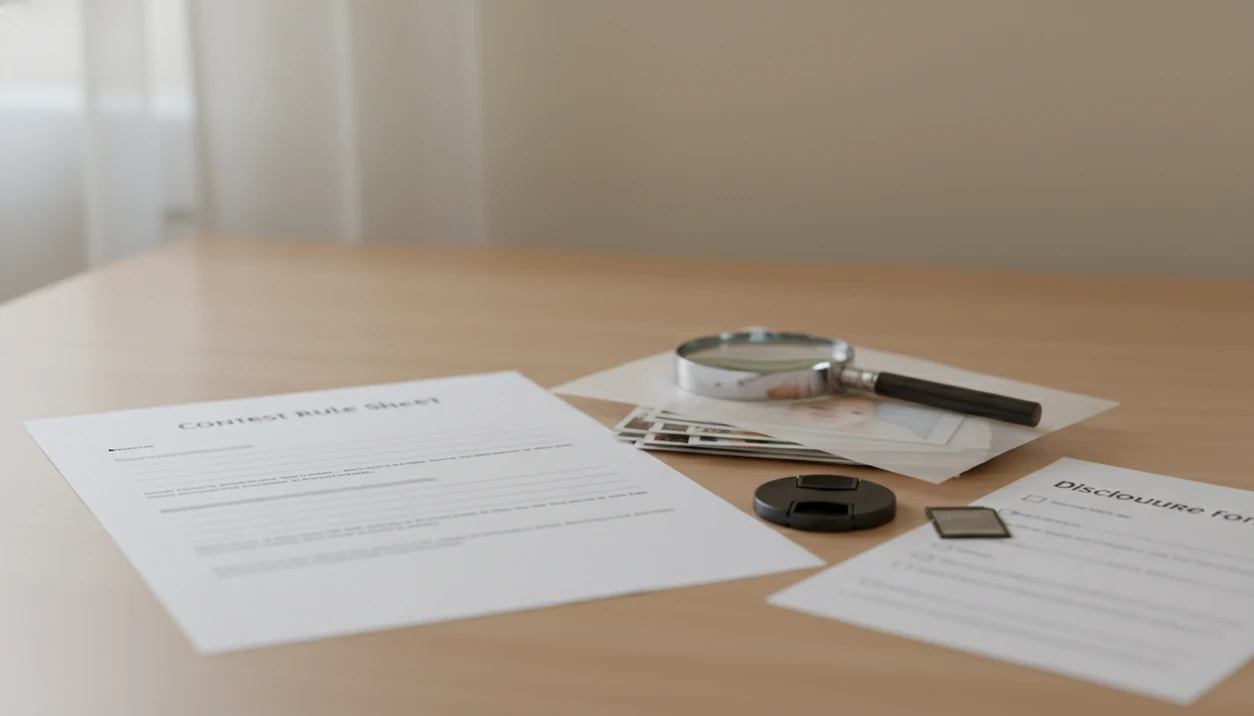
- Save dated screenshots of the rules, disclosure language, entry form answers, and any AI checkbox before submitting.
- Treat blog posts, captions, influencer reminders, and casual sponsor replies as helpful context only when they do not conflict with the official terms.
If two sources disagree, use the stricter official language or ask the administrator in writing.
Five AI Baby Photos Contest Rules Parents Must Know
- Many established competitions require photos to originate from a real photographic process, which can exclude fully generated baby images.
- AI-assisted editing may be allowed when it does not add, replace, or fabricate the main content.
- Fully synthetic babies, face swaps, generated backgrounds, and fabricated props may be banned or moved to altered-image categories.
- Child age, guardian consent, safety, nudity, and residency rules still apply even when AI tools are used.
- Failure to disclose AI use or prove original work can lead to disqualification and prize loss.
For parents, real-camera entries are often easier to verify than AI-generated images because the original file can show when, where, and how the photo was captured. A plain white crib sheet and soft gray light from a bedroom window around 10 a.m. can do more for eligibility than a dramatic generated nursery.
AI Baby Photo Contest Verification Behind the Scenes
AI baby photo contest verification works through originality, authorship, consent, and disclosure clauses rather than one universal AI standard. Administrators may compare the submitted entry with RAW files, original JPEGs, metadata, edit histories, and entrant statements.
The technical terms are simple enough: metadata is file information, and edit history is the trail left by software. Together, they help show whether the picture began as a real camera capture. For a technical example of how provenance and edit-history signals can be attached to media files, see the Coalition for Content Provenance and Authenticity specification at https://c2pa.org/specifications/specifications/2.0/specs/C2PA_Specification.html. A contest may not ask for proof during upload, but it can request proof before awarding a prize.
The core issue is not whether AI touched the image. The issue is whether AI changed the baby, scene, authorship, or truthfulness of the entry. In 2023, 72% of U.S. adults had heard at least a little about artificial intelligence, according to Pew Research source. That awareness makes AI transparency harder to ignore.
AI Photo Disclosure Clauses Parents Should Read Word for Word
AI photo disclosure means telling the contest when software helped create or materially edit the image. Read that clause word for word before uploading an AI-edited baby photo.
Common disclosure triggers include generative fill, background replacement, face enhancement, upscaling, denoising, object removal, and style transfer. Some contests only care about content-changing AI. Others ask about any AI assistance, even if you only cleaned up low-light noise from a phone photo.
A mandatory disclosure field is different from an optional caption note. If a form asks, “Was AI used?” answer that field directly. Do not hide a major alteration under a vague caption like “edited.” The caption draft beside the upload button is not the legal answer.
When rules are unclear, disclose conservatively and keep the original file. Quiet guessing is riskier.
Synthetic Baby Photo Rules Versus AI-Assisted Editing Rules
Synthetic baby photo rules are usually stricter because the baby, likeness, or scene may not come from a real photographic capture. AI-assisted editing is usually less risky when it cleans up a real image without changing the subject.
| Image type | Common examples | Typical contest treatment | Parent action |
|---|---|---|---|
| Real camera photo with light AI cleanup | Denoising, sharpening, mild exposure correction | Often allowed if rules permit normal editing | Save the original and disclose if asked |
| Real photo with major AI alteration | New outfit, new nursery, changed facial features | Often restricted or disallowed | Check alteration and AI clauses first |
| Composite photo | Baby combined with another background or prop image | May require altered category | Label clearly and keep source files |
| Face swap | Baby face replaced or blended | Usually high risk | Avoid unless explicitly allowed |
| Fully synthetic baby image | Prompt-generated baby with no real capture | Often banned from photo categories | Enter only if an AI category exists |
Some creative contests may allow synthetic images in a clearly labeled AI or altered category. Real newborn and baby photo contest ideas, photography tips, milestone shoots, and AI newborn photo inspiration should deliver safer planning and clearer storytelling, not a shortcut around consent or authenticity.
Proof Files for AI Baby Photo Contest Eligibility
Proof files help show that the image originated from a real child and a real camera capture. Do not overwrite the original file with an edited or AI-enhanced version.
- RAW files: Keep them if your camera or phone app creates them. They are strong evidence of capture.
- Original JPEGs: Save the first camera version before cropping, filtering, or exporting.
- Unedited exports: Keep a clean copy after basic crop or exposure work, before any AI tool.
- Editing histories: Save app timelines, project files, or before-and-after versions when available.
- Consent records: Keep guardian permission, photographer permission, and any model-release language.
A contest may request verification before awarding a prize, even if the upload form never asked for it. Rights and permissions can get confusing, so parents may want to read baby photo contest rights explained before submitting.
The pocket check is real. One edited export should never be your only copy.
When to Ask the Contest Organizer, Lawyer, or Pediatrician
Ask for help before submitting when the rules, rights, or safety of the photo are not clear. A quick written answer can prevent a disqualification, a prize dispute, or an unsafe setup.
Use the right person for the uncertainty:
- Ask the contest organizer to explain any unclear AI, alteration, category, or disclosure rule before you upload the entry.
- Save the organizer’s written reply with the submitted photo, original file, edit exports, screenshots, and entry confirmation.
- Contact a lawyer if the issue involves commercial use of a child’s likeness, copyright ownership, model releases, prize terms, or a dispute after judging.
- Check with a pediatrician before attempting any pose that could affect breathing, sleep position, neck support, warmth, or how the baby is held.
- Do not enter if consent, custody, guardianship, or the right to use the child’s image is uncertain.
A cute entry is not worth guessing over legal authority or newborn safety. If the answer is still muddy, pause and choose a simpler real-camera photo with clear permission.
Five Myths About AI Baby Photos Contest Rules
Myth 1: If the rules do not mention AI, AI-generated baby images are automatically allowed. Safer reading: traditional photography rules often still require a real photograph.
Myth 2: AI touch-ups are always minor edits. Safer reading: an edit is major if it changes the baby, background, clothing, or scene.
Myth 3: Parents can submit any AI-generated baby because they typed the prompt. Safer reading: many contests require entrant-created photographic elements, not just prompt input.
Myth 4: Judges will never detect AI. Safer reading: contests can request originals, metadata, edit histories, or written explanations.
Myth 5: Disclosure hurts every entry, so it is better to stay quiet. Safer reading: accurate disclosure protects eligibility when the contest permits AI. It also helps avoid prize disputes later.
A wrinkled muslin swaddle in the real photo is not a flaw if the rules value authenticity.
Safe Newborn Contest Photos With AI Inspiration
Parents can use AI for mood boards, outfit ideas, caption drafts, crop planning, or background inspiration without submitting a synthetic image. The safer path is to recreate the idea with a real baby, a simple backdrop, supervised positioning, and honest editing.
Use this contest-ready setup process:
- Choose an age-appropriate pose that keeps a caregiver within arm’s reach.
- Place the baby on a firm, safe surface with a simple backdrop.
- Remove clutter from the frame, including a diaper sleeve, pacifier clip, or burp cloth.
- Shoot the real photo before opening any AI or editing app.
- Crop for the entry form without cutting off important hands, props, or faces.
- Disclose AI help if the contest asks or if the edit materially changed the image.
No entry should show unsafe newborn posing, exploitative nudity, misleading likeness use, or a child whose guardian has not consented. For sleep-surface and positioning safety context, compare posed newborn-photo ideas against the American Academy of Pediatrics safe sleep guidance at https://www.aap.org/en/patient-care/safe-sleep/. For public sharing choices, the question is it safe to post baby photos online deserves a separate read.
Apps such as Newborn Photo App, Canva, and Babypics can help parents plan a safer entry, but official rules still control eligibility.
Limitations of AI Baby Photos Contest Rules
AI baby photos contest rules have real gray areas, and parents cannot control every eligibility decision. The final call usually belongs to the contest administrator.
- There is no universal AI disclosure standard across baby photo contests.
- Rules can change between contest years, sponsors, regions, and categories.
- Some contests may reject AI content because of copyright, training-data, or authorship concerns.
- AI tools can over-smooth skin, distort fingers, alter facial features, or create unrealistic newborn anatomy.
- Even allowed AI edits may reduce authenticity if they change what the baby actually looked like.
- A contest may make final eligibility decisions at its own discretion.
- This article is guidance, not legal advice or a substitute for official rules.
In a 2023 global consumer study, 52% of respondents said they were concerned about AI being used without transparency to create deceptive content source. That concern explains why disclosure language keeps getting sharper.
If a contest feels vague, pause. Scam risk and prize terms also matter, especially in vote-based promotions, so review a baby photo contest scam checklist before paying fees or sharing widely.
FAQ About AI Baby Photos Contest Rules
Are AI baby photos allowed in contests?
AI baby photos are allowed only when the contest rules permit AI-generated or altered images. If the rules require an original photograph, assume a fully synthetic baby image is not eligible.
Can I use AI retouching on a baby contest photo?
Light AI cleanup may be allowed when it does not change the baby, setting, or main content. Content-changing edits can violate originality or alteration rules.
Do baby photo contests require AI disclosure?
Some contests require AI disclosure through a form field, checkbox, or eligibility statement. Parents should answer accurately whenever the contest asks about AI, editing, or altered images.
What counts as a synthetic baby photo?
A synthetic baby photo is a fully or partly AI-created image that does not come from a real camera capture of the baby shown. It may include generated faces, bodies, backgrounds, or props.
Can AI remove baby blemishes before I enter?
Minor blemish cleanup may be accepted in some contests. Heavy skin smoothing, facial reshaping, or feature alteration can be risky.
Are AI-generated backgrounds legal in baby photo contests?
AI-generated or replaced backgrounds may count as significant alteration unless the rules clearly allow them. Some contests place these images in altered or creative categories.
Can contest judges detect AI edits in baby photos?
Judges or administrators may review metadata, request original files, inspect edit histories, or compare before-and-after images. Detection is not guaranteed, but rule violations can still lead to disqualification.
Should I keep the original baby photo file?
Yes, keep the RAW file or original JPEG as proof of camera origin and authorship. Do not overwrite it with an edited or AI-enhanced version.
Can AI baby photos win contest prizes?
AI baby photos can win only when the contest rules allow them and the entry meets disclosure, category, consent, and eligibility requirements. The contest’s official rules decide prize eligibility; planning apps and editing tools cannot override them.